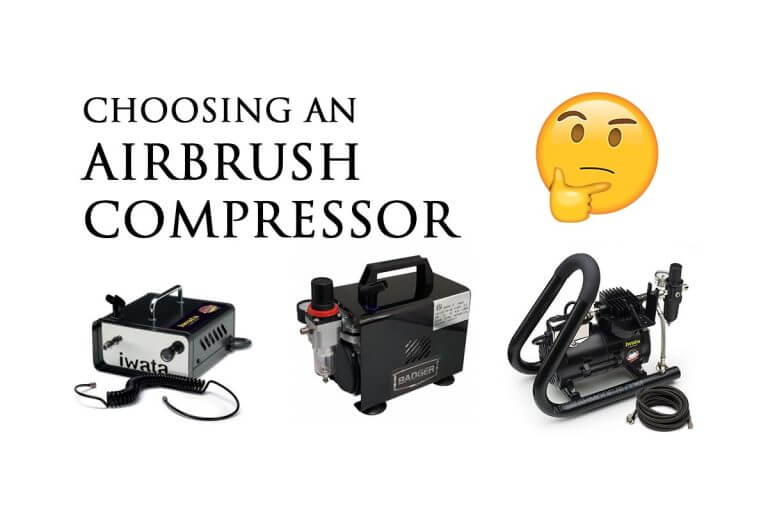
Specs to Check Before You Buy
There is no universal minimum spec that fits every airbrush, paint and subject. Use this as a checklist of what to look up, and take the numbers from the manufacturer's sheet for the model you are considering.
| Specification | What to look for |
|---|---|
| Working pressure | A regulated range that covers the pressure your airbrush and paint need. |
| Airflow | The maker's airflow figure (L/min or CFM) at your working pressure, not just a headline maximum. |
| Tank | Stored air that smooths piston pulses. Useful size depends on session length; tankless units can suit short detail work. |
| Noise | A decibel figure with the measurement distance and load conditions, so you compare like with like. |
| Motor rating | One input, not a prediction of output pressure, airflow or duty cycle. |
Use the sizing tool below for an illustrative starting point, then confirm the actual model's specs.
What the Spec Numbers Actually Mean
An airbrush compressor for model painting has to deliver stable, moisture-free air at the right pressure for your nozzle. Here is what each spec controls.
Horsepower, Pressure and Airflow
Horsepower describes the motor, not the air delivered at the brush. Two compressors with the same motor rating can have different pumps, regulators and tanks, and therefore different working pressure and airflow. The figures to compare are the manufacturer's rated working pressure, its maximum pressure, and its airflow at the pressure you will actually spray at.
That is why a horsepower number alone cannot tell you whether a unit will hold a steady 20 psi through a long base-coat session. Ask for the airflow at your working pressure and the duty rating, then check the regulator and moisture trap on the actual unit.
Attributed example: Iwata lists the North American IS975 Power Jet Pro at 1/6 HP with a 2 L tank, 1–50 psi working pressure, 75 psi maximum, 62 dB and 110–120 V 60 Hz. Those figures describe that model only; they are not a horsepower-class rule. Source: iwata-airbrush.com.
What the Tank Does
A tank absorbs the pulse from the piston and gives you a reservoir of steady air, so pressure at the brush is less likely to surge with each stroke. It does not raise the pressure; the regulator sets that.
Whether you need a tank, and how large, depends on how you spray. A tankless unit can be enough for short detail sessions, while long base-coat or priming sessions put more demand on the pump and benefit from more stored air. Compare tank volume together with airflow and duty rating, not as a universal minimum.
Moisture Trap, Regulator, and Why Both Matter
1. Moisture Trap
Catches condensed water droplets before they reach the brush to prevent fish-eye and colour contamination, critical for waterborne acrylics.
2. Regulator
Lets you set the exact PSI you want at the brush regardless of tank pressure, ensuring consistent airflow throughout the session.
Many dedicated airbrush compressors include both; check the actual unit before you buy.
Noise Level and Decibel Ratings
Noise figures are only comparable when they are measured the same way. A maker's dB number may be taken at a different distance or load, so check the conditions before comparing two units. If noise matters where you spray, look for a measured figure at a stated distance and use the quietest unit that still meets your pressure and airflow needs.
Single-Piston
Fires once per revolution. Rhythmic pulse sound. Standard for most budget units.
Dual-Piston
Fires alternately. Can run more smoothly, but noise and output depend on the specific model and its rating.
Single Piston vs. Multi-Piston
| Factor | Single Piston | Dual Piston |
|---|---|---|
| Typical design | One piston; rhythmic pulse | Two pistons; often smoother |
| Output | Read the model's rated pressure and airflow | Read the model's rated pressure and airflow |
| Noise | Check the maker's measured figure and conditions | Check the maker's measured figure and conditions |
| Duty rating | Check the stated duty cycle | Check the stated duty cycle |
| Best for | Short to moderate sessions | Longer or heavier sessions, if airflow and duty rating support them |
When a Single-Piston Is No Longer Enough
Switching to a 0.5 mm nozzle
Moves more air. Check the compressor's airflow at your working pressure; a horsepower class alone does not tell you whether it will keep up with a wider nozzle and heavier primer.
Running two airbrushes simultaneously
Running two brushes raises airflow demand. Look for a unit whose rated airflow at your working pressure covers both brushes, and check its duty rating; piston count and horsepower alone do not guarantee that.
Sessions longer than 90 minutes
Long sessions give the motor less time to cool. Check the manufacturer's duty rating and tank refill behaviour; a unit with a higher duty rating or more stored air may suit you better, but confirm it in the specs.
Match Your Compressor to Your Setup
Answer three questions about your subjects, airbrush and session length for an illustrative starting point.
Then check the actual model's manual and spec sheet before buying. Free, no registration required.
Use the Airbrush Compressor Size CalculatorFrequently Asked Questions
Q1: What PSI do I need for airbrushing scale models?
Many modellers work somewhere around 12–25 psi, with thinner mixes toward the lower end and base coats toward the higher end. That is a starting range, not a rule: the airbrush, paint and maker's guidance decide the setting.
Q2: Do I need a tank on my airbrush compressor?
Not necessarily. A tank smooths piston pulses and helps hold steady pressure, which matters more on long coats. Tankless units can suit short detail sessions; compare tank size with airflow and duty rating rather than treating 2 L as a minimum.
Q3: What is the difference between single and dual-piston?
Dual-piston units can run more smoothly and sustain higher output depending on the model, but they usually cost and weigh more. Check the rated pressure and airflow rather than assuming two pistons is better for every job.
Q4: How loud is a typical airbrush air compressor?
Figures vary widely, and they are only comparable when measured the same way. Look for a measured figure with its distance and load conditions, and choose the quietest unit that still meets your pressure and airflow needs.
Q5: Can I use a regular workshop compressor?
A regulated shop compressor can work if it supplies suitable air, but many are louder and bulkier than hobby units. Check the actual noise figure and whether the regulator holds your working pressure before committing.