Airbrush for Models: Choosing the Right Setup
For plastic scale model painting, choose an airbrush whose nozzle/needle range, feed, action and spare parts support both broad coverage and controlled detail, then pair it with regulated air whose documented pressure, airflow and duty suit your paints. A double-action gravity-feed brush is a common starting point, not the only workable one.
The Scale Modeler's Challenge
Scale models put different demands on an airbrush than most other hobbies. You are covering the full hull of a 1/48 aircraft one hour, then pinpoint-spraying a cockpit interior the next. Inexpensive brushes vary widely: the useful question is whether the specific model has the nozzle/needle sizes, seals and spares your paints require.
The Five Things a Scale Model Airbrush Must Do
Cover large surfaces evenly
Consistent, wet coats of primer and base color across wide areas without streaking or dry-edge buildup. For 1/48 fuselages or 1/35 tank hulls.
Hold fine detail control
Controlled, low-volume spray for panel lines and soft camouflage edges. Working pressure depends on the airbrush, paint and airflow — set it by test rather than assuming one number. For precision cockpit work.
Change colors quickly
Gravity-feed cups are usually quicker to rinse than siphon bottles during multi-colour work, which matters when a scheme has many changes. For complex camouflage patterns.
Clean thoroughly between sessions
Check that the maker lists the seals and internal materials as compatible with the paints and cleaners you use — some solvents attack some seals. For long-term tool durability.
Match model paint chemistry
Read the maker’s seal guidance against your paint line; acrylics, enamels and lacquers are not interchangeable across every airbrush. For lacquer-based priming.
Nozzle Size and Feed Type
The Nozzle Hierarchy
- 0.2 – 0.25 mm: Fine work with thin paint; heavier pigment loads raise clog risk. Check the maker’s recommended use.
- 0.3 – 0.35 mm: A common mid-size range for general work; suitability still depends on paint, pressure and technique.
- 0.4 – 0.5 mm: Faster coverage on larger subjects (1/32 aircraft, ships), usually easier to clean and less precise.
Feed Dynamics
Gravity-feed is a common choice for model work: the top-mounted cup feeds paint down to the nozzle and is usually quick to rinse between colours.
Siphon-feed is a valid choice for large volumes; bottle changes add cleaning steps. Nozzle diameter alone doesn’t predict line width — needle taper, paint viscosity, pressure and distance also matter.
Double-Action vs Single-Action
A double-action airbrush lets you control airflow and paint flow independently with one trigger. Press down for air; pull back for paint. This makes feathered edges and graduated shading easier to control. A single-action brush can also spray these with a preset flow and careful technique, but it cannot change paint flow mid-pass.
If on-the-fly control matters for your work, start with double-action and practise trigger discipline; if repeatable coverage dominates, single-action is a valid alternative.

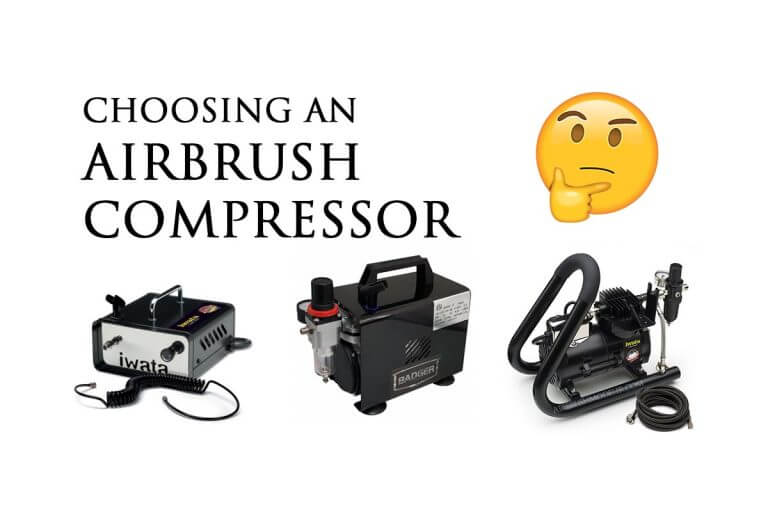
Compressor: The Piece Most Beginners Get Wrong
A common mismatch is pairing an airbrush with an air supply whose working pressure, airflow or duty is undocumented. Scale painting needs stable, controllable air, but the numbers depend on the brush and paint. There is no valid horsepower-to-PSI conversion: horsepower alone does not tell you working pressure, airflow, duty cycle or tank size.
| Spec | What to check | Why it matters |
|---|---|---|
| Working pressure | Adjustable range, with the regulator’s usable range | Lets you set and repeat a pressure at the brush |
| Airflow | Documented airflow at working pressure | Supports atomisation and recovery under use |
| Duty cycle | Maker’s stated on/off duty | Long sessions without overheating |
| Tank / tankless | Type stated, with documented output | A tank can buffer pulses; tankless units vary |
| Noise | Maker’s dB figure and test conditions | Bench comfort; compare like-for-like tests |
Paint Compatibility: The LEA Rule
Acrylics
Many hobby acrylics are water-borne or water-miscible, but binder and thinner are product-specific. Check the label; fast tip-dry is common.
Enamels
Solvent-based, slow drying. Excellent for oil-wash weathering layers.
Lacquers
Fast-drying and durable. Confirm seal compatibility with the maker; some solvents degrade some seals.
LEA is a common ordering convention for compatible chemistries, not a guarantee. Test on scrap and follow each product’s label.
Check Paint Layering OrderAirbrush Troubleshooting Diagnostic
| Symptom | Possible causes | First check |
|---|---|---|
| Spattering or spitting | Paint too thick, nozzle/needle damage, air-supply fluctuation | Check paint against its label, inspect the nozzle/needle, confirm working pressure |
| Tip-dry | Paint drying on the needle, high airflow, thin paint | Wipe the tip, adjust thinning/retarder per label, check airflow |
| Uneven coat | Pressure fluctuation, distance/speed, clogged nozzle | Test on scrap, check the air supply and nozzle |
| Paint not flowing | Clog, needle not retracting, paint too thick | Check nozzle/needle and paint consistency before disassembly |
| Bubbling in cup | Intentional backflush, loose nozzle/seal, needle packing | Check whether backflush was intended, then seals per the manual |
These are checks, not a diagnosis: change one variable at a time and use the maker’s manual. A hiss at the tip does not by itself prove sufficient working pressure or airflow under load.
Run Full Diagnostic →Frequently Asked Questions
Q: What is the best airbrush for scale models?
A: There is no single model. Match feed, action, nozzle/needle sizes and spare parts to the jobs you paint; a double-action gravity-feed brush in a mid-size nozzle range is a common starting point.
Q: Can I use a cheap airbrush?
A: Sometimes. Judge the specific model by documented nozzle/needle sizes, seal compatibility, spares and cleaning instructions rather than price alone.
Q: Do I need a tank?
A: Not necessarily. What matters is documented working pressure, airflow and duty cycle for your airbrush and paint. A tank can buffer pulsation; tankless units vary by model.
Ready to choose your perfect setup?
Use the selection order above to shortlist models, then verify current specs and parts with the maker or retailer.
Explore Our Best Airbrush PicksCheck current specifications and spare-part availability with the seller