Which Airbrush Thinner Do You Need? Start With Your Paint Type.
The right airbrush thinner depends on the exact paint line, not just the family name. Acrylic can be waterborne, alcohol-based or solvent-based; lacquer and enamel lines also differ. The maker's thinner for that product is the starting point, and the wrong solvent can damage a paint film.
| Your Paint Type | Compatible Thinner | Key Note |
|---|---|---|
| Waterborne acrylic (for example Vallejo Model Color/Model Air, Citadel, AK water-based lines) | The acrylic thinner or medium named for that line | Use water only if the label permits; a thinner from another brand is not automatically compatible |
| Other acrylic lines (check the label) | The thinner or reducer the maker names for that exact line | Acrylic does not by itself tell you the carrier; do not assume "acrylic thinner" is water-based or mild |
| Tamiya Color Acrylic (X / XF) — a named line-specific example | Tamiya X-20A Acrylic Thinner | Tamiya's 81040 page names X-20A as thinner, wipe and cleaner and lists an organic-solvent component; do not infer the full paint formula or interchange it with lacquer or enamel thinner |
| Lacquer / nitro (Mr Hobby Mr. Color, Tamiya Lacquer) | Dedicated lacquer thinner | Strong solvent — ventilate; clean with lacquer thinner |
| Enamel (Humbrol, Revell, AK, AMMO of Mig enamels) | The enamel thinner named for that line | Drying varies by line; ventilate; clean with enamel thinner |
Table note: This table gives a starting thinner category only. Use the product named on that paint line's label or maker guidance; a similar product from another brand is not automatically compatible.
Maker-specific example: Tamiya's Japanese product page for item 81040 identifies X-20A 250 mL as the thinner, wipe and cleaner for Tamiya acrylic paints and lists its component as an organic solvent. Tamiya 81040 product page. The page supports the named X-20A pairing, not a conclusion that every Tamiya acrylic paint or thinner is water-based, universally mild, or interchangeable with lacquer or enamel thinners; it also does not establish the full paint formula.
Acrylic Airbrush Thinner: What It Does and When to Use It
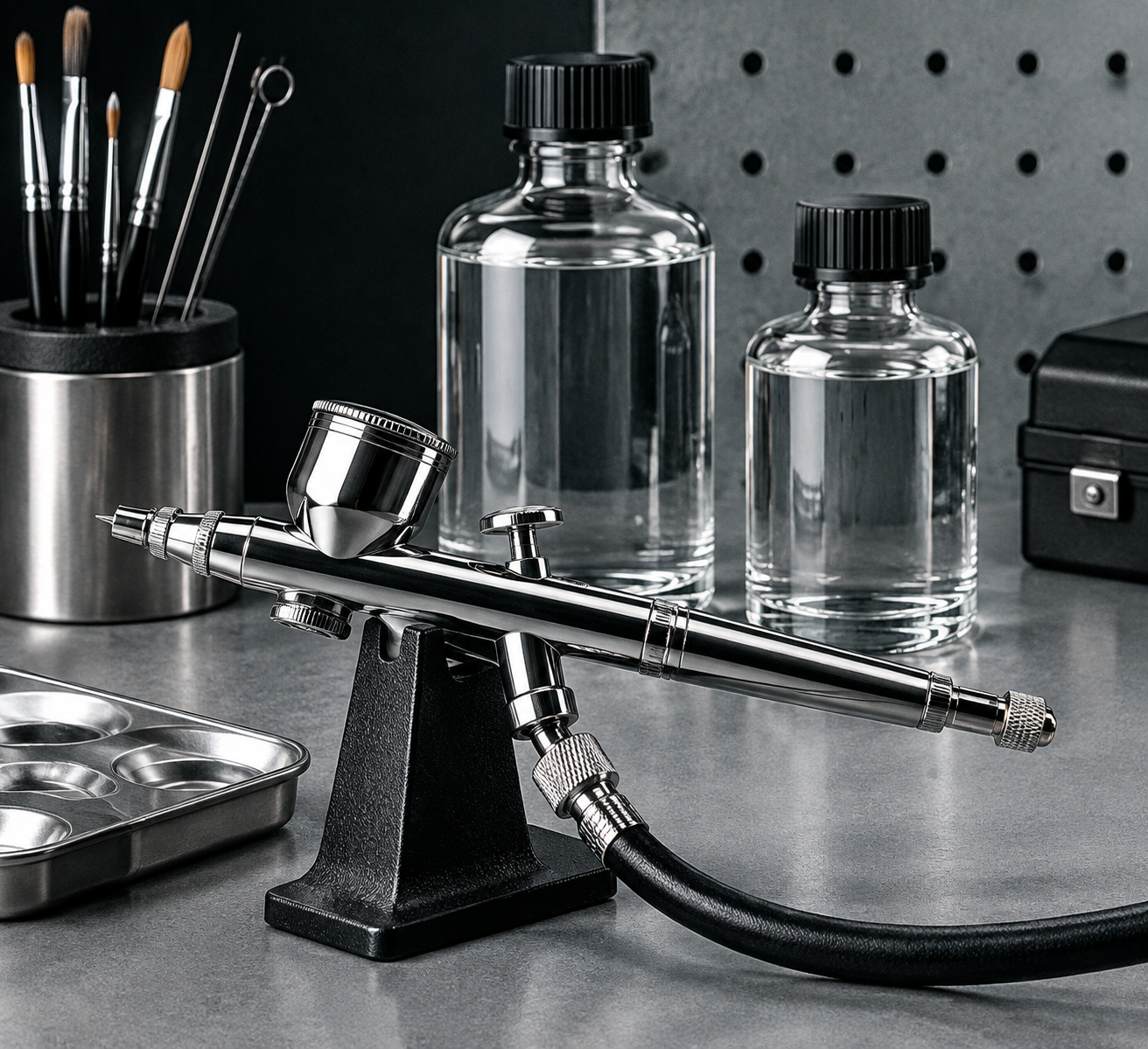
For waterborne acrylic lines, use the acrylic thinner or airbrush medium named for that product. These products are formulated to reduce viscosity while preserving the line's binder system, but "acrylic" alone does not tell you the carrier: some acrylics are waterborne, while others are alcohol- or solvent-based and need the maker's reducer. Read the label before choosing a thinner.
Some waterborne acrylic labels allow water; others call for a proprietary thinner or medium. Follow the exact label for the paint line you are using, and test a small mixture on scrap before spraying a model. Check how it sprays, levels and adheres under your conditions rather than assuming water and the maker's thinner behave the same. A medium from a different brand is not automatically compatible.
Published examples, not universal ratios. Vallejo's Model Color airbrush guide gives one named basecoat — Field Blue 70.964 — as two parts 71.261 Airbrush Thinner to two parts paint (1:1 thinner:paint), then three drops of 71.262 Flow Improver per ten drops of paint, with the drops counted against the paint. Vallejo guide (PDF) Createx's Wicked Colors sheet gives 10–30% reducer depending on colour and tip, around 10% at a 0.5 mm tip, Transparent Colors at 25–30 psi and at least 10 minutes' acclimation — for that line only. Createx Wicked Colors TDS (PDF) GOLDEN's High Flow sheet notes that some pigments are unsuited to fine nozzles or fine tips, which is a line-scoped limitation rather than a rule about all craft acrylic. GOLDEN High Flow sheet
Iwata's paint guide recommends Medea products for water-soluble paints and directs readers to the paint label or manufacturer for other materials — a maker recommendation for a product family, not a universal thinner rule. Iwata paint guide
Understanding Additives: Thinner vs. Flow Improver
Airbrush Thinner
SCENARIO: The primary tool for reaching spraying consistency
Reduces viscosity — it makes heavy paint fluid enough to pass through a fine needle without clogging.
Flow Improver
SCENARIO: An add-on for leveling or persistent tip-dry
Reduces surface tension — it helps paint level on the surface and slows tip-dry. It does not thin the paint significantly.
Retarder
SCENARIO: For high-heat environments or fine detail work
Extends the drying (open) time. It is used when tip-dry is severe or ambient temperature is high.
Lacquer Paints Need Lacquer Thinner — No Substitutes
Lacquer and nitro paints — such as the Mr Hobby Mr. Color range and Tamiya Lacquer — require a dedicated lacquer thinner. Water and acrylic thinners cannot break down lacquer resins.
An incompatible solvent can make the paint seize, separate, or cure with a rough or frosted texture; the exact result depends on the product.
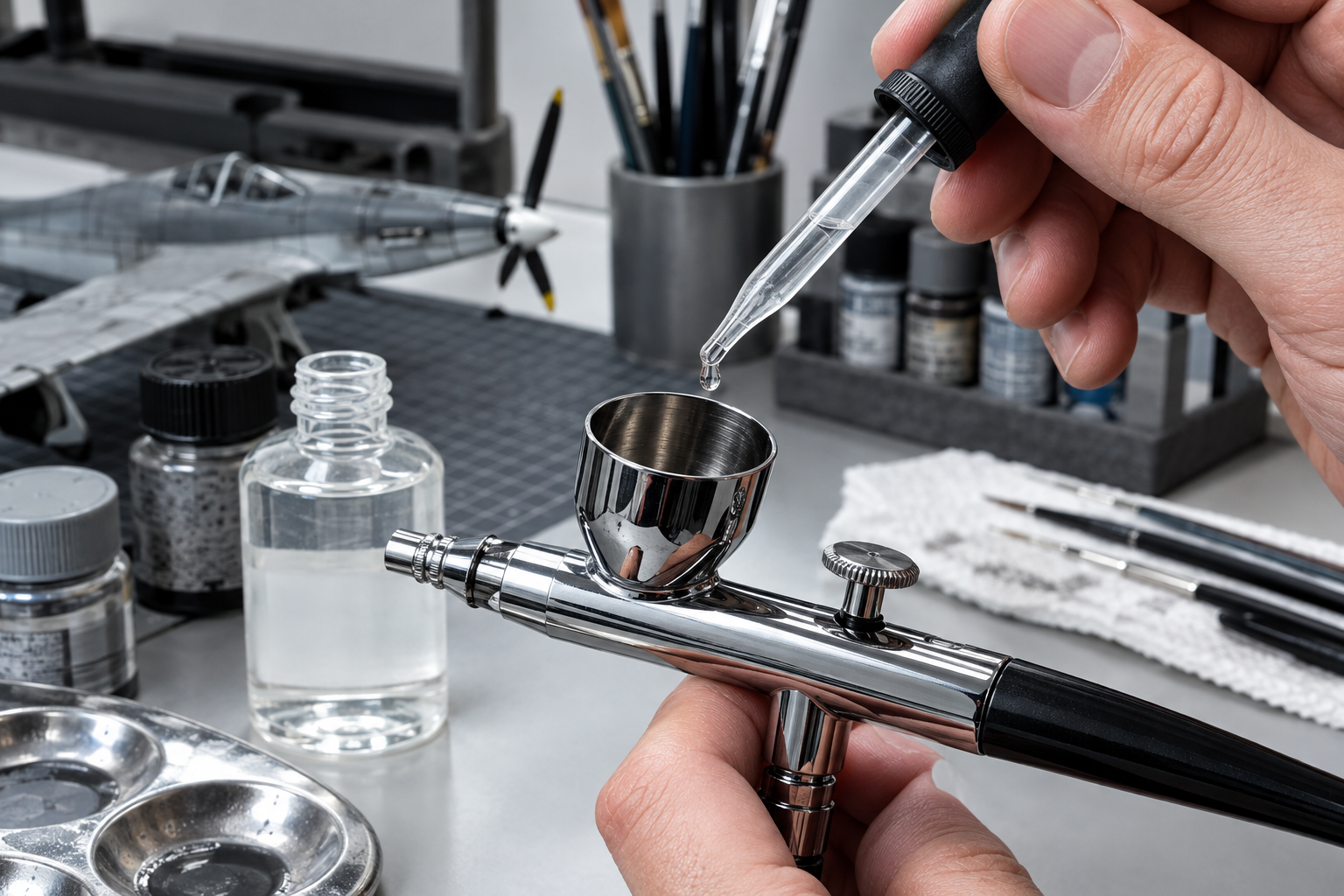
Lacquer thinners are strong organic solvents. They produce noticeable fumes, so adequate ventilation is required before spraying lacquer through an airbrush — a spray booth, open garage, or outdoor space. Drying and recoat timing depend on the actual paint, thinner and conditions; some products are formulated for extended working time. Follow the exact maker's reduction and recoat instructions for that lacquer line rather than assuming a universal drying speed.
Enamel Paints: Use the Maker's Named Enamel Thinner
Humbrol enamel paints are paired by the maker with Humbrol Enamel Thinners, and Revell enamel paints with Revell Color Mix. For the enamel ranges from AK Interactive and AMMO of Mig, use the thinner named for that specific range; a compatible mineral spirit may be an option where the maker says so. Solvent chemistry can overlap across acrylic, lacquer and enamel categories, so match the exact paint line and thinner rather than relying on the family name. Water is not a substitute for these solvent-based enamels.
Enamel lines are often formulated for a longer open time than many acrylics and lacquers, which can be useful for brush blending and pin washes but requires patience at the airbrush. Drying and recoat times vary by product, so follow the label for the exact enamel line. Fumes from enamel thinners are noticeable, so ventilation is required.
AIRBRUSH THINNER — COMMON QUESTIONS
If you're deciding which paint type to buy — or figuring out how to layer lacquer, enamel, and acrylic coats safely — our comprehensive guide covers chemistry, compatibility, and the LEA layering rule.
Free technical resource for modelers.