
Beginner Airbrush Set:
Filter by Budget and Ease
For a first airbrush set, decide budget and what you will paint first, then choose the easiest action type and nozzle you will actually clean.
Stop Guessing at Amazon Listings
Marketplace listings and forum threads often push dual-action kits with long accessory lists. The decision order below stays fixed — budget, use case, ease, cleanup — so a beginner airbrush kit is judged by components and documented specs, not by star ratings or brand hype.
Run these four checks in order
Lock the filter order first; shortlist kits second. Do not skip ahead to brand names.
Budget
Set a hard ceiling for the whole kit path. A low ceiling still works if the compressor is usable; higher is wasted if the gun is hard to clean.
Use Case
Name the first jobs: base coats, fine lines, or multi-colour work. Broad coats favour larger nozzles; fine detail requires control.
Ease of Use
Decide your day-one variables. Single-action is simpler; Gravity feed is usually easier to load and rinse at the bench.
Maintenance
Assume you will clean often. Prefer kits whose nozzle and needle come apart without special tools and have stocked spares.
If a listing cannot clear all four filters, keep scrolling — even when the star rating looks strong.
Acceptable kit spec ranges
Starter Path
- ✓ Dual-purpose: gun + compressor
- ✓ Air supply with adjustable pressure
- ✓ Nozzle/needle size sold as a spare
- ! Check: no way to set pressure
Balanced Bench
- ✓ Documented steady output (tank or suitable tankless)
- ✓ Moisture control / Water trap
- ✓ Action and feed chosen for your first jobs
- ! Check: airflow and duty cycle not stated
Longevity Bias
- ✓ Clearer spare-parts story
- ✓ Documented noise and duty cycle
- ✓ Serviceable workshop design
- ! Skip if: Marketing Max-PSI focus
The Compressor Sizing Anchor
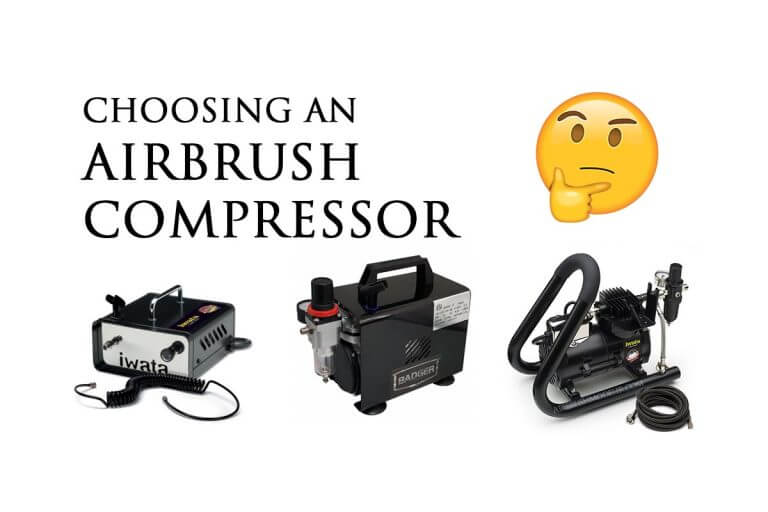
Don’t size an air supply from horsepower. Check the maker’s documented working-pressure range, airflow at working pressure, duty cycle and noise, then confirm the airbrush and paint you use work within them. A regulator and moisture trap help you repeat a setting; a tank is one way to buffer output, not a requirement for every bench. Iwata’s FAQ notes that working pressure varies with the airbrush and material. Use the calculator for arithmetic, then verify the listed specs.
Action, Feed, and Nozzle Class
| Choice | On the Bench | Beginner Ease | Cleanup Notes |
|---|---|---|---|
| Single-action | Trigger controls air; paint is set by adjustment. | Fewer variables; easy learning curve. | Simpler mental model; still needs teardown. |
| Dual-action | Trigger controls air and paint (Down/Back). | Steeper curve; more control for fades. | More surfaces to keep clean; practice needed. |
| Gravity Feed | Cup on top; paint feeds down into mix. | Fast loading; easy for small sessions. | Fastest rinse between color changes. |
| Siphon Feed | Paint drawn from bottle below or beside. | Good for large coverage/volumes. | Bottle changes add cleaning steps. |
Nozzle Size Reality
Nozzle size is one variable. A fine nozzle with thick primer raises clog and tip-dry risk; a larger setup covers faster but gives less control. Diameter alone doesn’t predict line width — check the maker’s needle/nozzle options and match them to your first jobs and paints.
How Single-Action Starts
Connect to air, load paint, press trigger for air while paint volume is set on the gun. A simple loop while you learn spray distance and coats.
The 12-Point Pre-Buy Checklist
Air supply — Tanked or tankless; are output and duty documented?
Regulator — Can you set modelling pressures?
Moisture control — Water trap included?
Stated pressure — Working-pressure range and airflow documented?
Action type — Single or Dual action stated?
Feed type — Gravity, siphon, or side feed?
Nozzle size — mm size printed on listing?
Teardown — Removed without mystery tools?
Spare parts — Tips/needles sold separately?
Hose & fittings — Matching adapters included?
Noise — Maker’s dB figure and test conditions stated?
Paint system — Cleaning advice matches your paint?
A complete accessory pile does not fix a missing regulator or an unserviceable tip. Kit “value” is steady air plus a gun you will clean.
Common first-buy mistakes
Chasing max psi
Models care about steady flow. High-psi claims without a tank/regulator story are a weak reason to buy.
Smallest nozzle
Fine tips are poor general starters for primers. Match tip class to the first month’s jobs.
Skipping Cleanup
If the gun is awkward to strip, you will postpone cleaning and ruin the needle with dried paint.
"Check the maker's current specification and parts list for the exact model before you commit."
Buying guide for scale model builders
Beginner Kit Questions
Do I need a dual-action airbrush?
No. Single-action is a valid path for ease. Choose dual-action if you want independent air/paint control and will practice trigger discipline.
What should be in a beginner set?
At minimum: the airbrush, an air source with a way to set pressure, a matching hose, and cleaning tools. A tank is optional; check the specific unit’s documented pressure, airflow and duty cycle.
What nozzle size is best?
There is no universal size. Check the maker’s nozzle/needle options and the paint maker’s thinning guidance: fine tips suit thin paint and detail, while larger tips suit broader coverage.
Does the compressor need a tank?
Not necessarily. What matters is documented working pressure, airflow and duty cycle for your airbrush and paint. A tank can buffer pulsation, but tankless units differ by model; check the specific unit’s specifications and reported behavior at your working pressure.
Lock the filter order, then refine your gun choice
You now have a budget-tier component map and a twelve-point pre-buy checklist. Next, refine candidates with the best-airbrush guide.
Compare listings on published specifications.