What the P100 label rates
P100 sits in the P series of NIOSH particle filter classes. NIOSH's filtering facepiece page sets out nine classes as three efficiency levels (95, 99 and 99.97 percent) crossed with three oil-resistance designations, and notes that the 99.97 percent class is printed as "100." P100 therefore means at least 99.97 percent of airborne particles captured in certification testing, with the oil-aerosol resistance of the P series.
Oil-aerosol resistance is a property established in certification testing. It is not a finding about your paint: calling a product oil-based does not establish that your spraying produces an oil aerosol hazard, and the name of a paint line is not a hazard assessment.
What P100 does not rate is vapor. The same page states that filtering facepiece respirators provide protection against particles, but not gases or vapors. A P100 marking tells you the efficiency class of the particle filter; it says nothing about vapor capacity.
The 99.97 percent figure is a certification result, not a promise about the air in your workroom. It is not complete removal, not a safe room concentration, and not an assigned protection factor.
What an organic vapor approval covers
Organic vapor names a class of vapor-removing approval, not a universal solvent rating. An element marked organic vapor is approved for the vapors specified in that approval. The phrase itself does not supply a list of solvents, and it does not mean every organic chemical. NIOSH's Guide to Air-Purifying Respirators treats element selection as contaminant-specific, which is why the approval and its stated scope matter more than the class name on the packaging.
An organic vapor element carries no particle rating by itself. A buyer who reads "organic vapor," buys it, and assumes the paint mist is handled has covered only part of what the session may produce.
The combination element carries a particle class and a vapor approval in one unit, which is what OV/P100 refers to. If the marking is only P100, there is no vapor approval on it. If it is only organic vapor, there is no particle approval on it.
Three label combinations you can end up holding
Marking on the element | Covers | Leaves open |
|---|---|---|
P100 or P95 particle filter | Airborne particles at the marked efficiency class | Vapor from paint, thinner and cleaner |
Organic vapor cartridge or canister | The vapors named in its approval | Paint mist and other particles |
Organic vapor with P100 (OV/P100) | Particles and the approved vapors, where both approvals are printed | Fit, change schedule, oxygen-deficient or IDLH atmospheres |
What an assembly is approved to do depends on the element attached to it. NIOSH's respirator type comparison says elastomeric half-mask and quarter-mask respirators protect against gases, vapors and particles when equipped with the appropriate filter, cartridge or canister. The same facepiece can be a particle-only device or a two-stream device depending on what is attached, so confirm that the element you buy is approved for that facepiece rather than assuming a class name travels between them.
Check the approval marking too, not just the class name. NIOSH approval labels carry a testing and certification number, and the agency maintains a Certified Equipment List to confirm that a number is valid. A filter body with no readable approval marking is an unknown, whatever the packaging said.
Reading the label for an actual airbrushing session
Atomized paint is the visible part of an airbrush session. Vapor is not visible, and whether it is present depends on the products. Lacquer and enamel systems commonly bring solvent vapor with them. A water-based acrylic may carry much less, though that does not settle the question either, because the safety data sheet for that specific bottle is what records the hazardous ingredients.
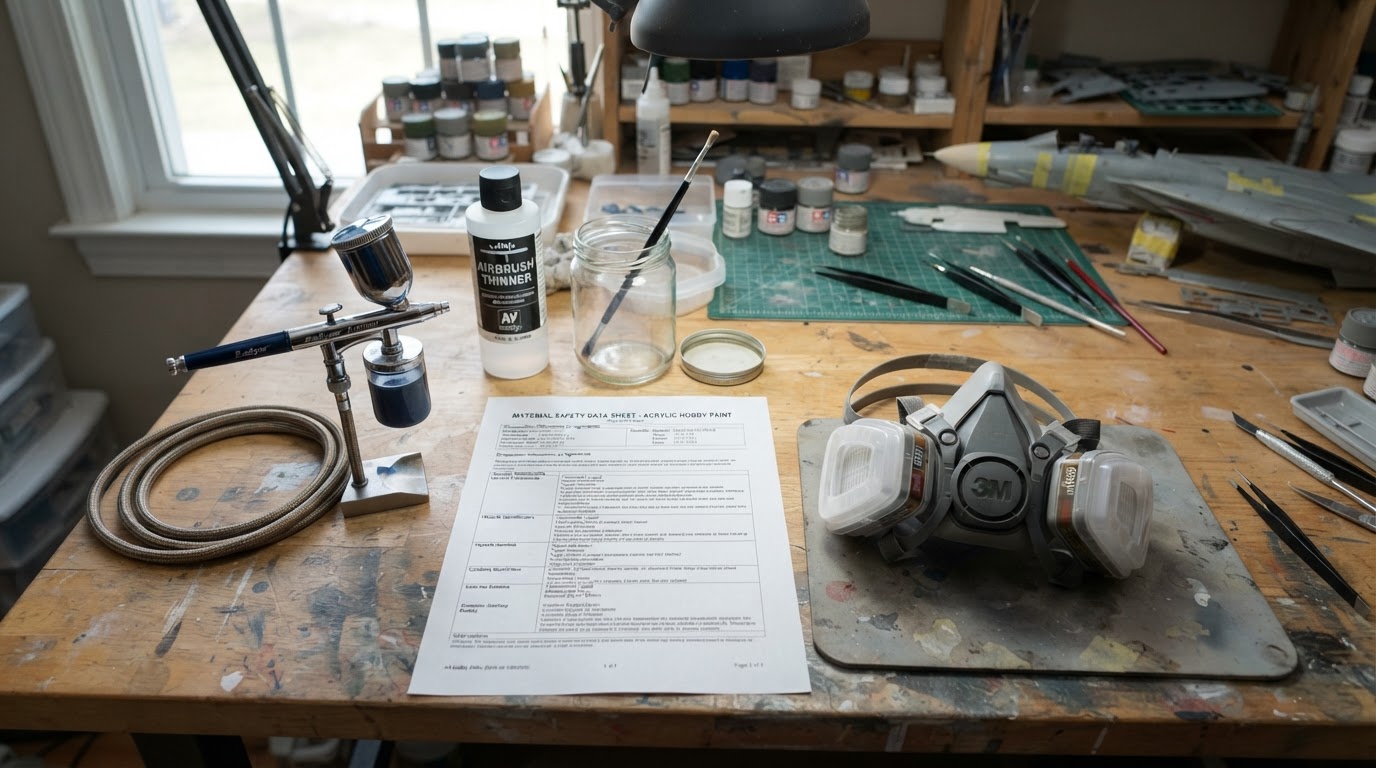
Read the SDS for everything that enters the cup or the cleaning jar, paint, thinner and cleaner, and note the hazardous ingredients and the manufacturer's exposure guidance. A "water-based" front label is not a hazard assessment, and a solvent-based cleaner used for a final flush can matter as much as the paint.
A cleaning pot's filter is a separate component with a separate job. It captures spray-out before it reaches the room, while a respirator element filters what you are about to inhale. Replacing that pot filter is covered in the CL300 cleaning pot filter guide, and it does not change what your respirator element has to cover.
Matching an ingredient name to a cartridge is not the same as selecting protection. The SDS tells you what to check; it does not by itself establish the airborne concentration, the exposure duration, or whether a particular element is adequate for either. Those decisions need the exact product SDS, the way you work, the exposure controls in place, an approved compatible facepiece and element pairing, fit, and the manufacturer's change schedule. Where the hazard or the exposure is not characterized, the next step is the manufacturer's guidance and a competent safety assessment together with setup controls, not a higher-rated element chosen by guesswork.
What the label still cannot settle
Fit is one gap the label cannot close. NIOSH's filtering facepiece guidance is explicit that a user seal check each time you don the respirator is not a substitute for fit testing, and a tight-fitting elastomeric facepiece needs a workable seal as well. Protection that leaks around the seal is not the filtration efficiency printed on the box.
Filter efficiency is not the same as overall protection. The efficiency class describes the filter medium under test. What you actually receive depends on the whole assembly: the facepiece, the approved pairing, the seal you achieve, and how you wear and maintain it. A higher particle class does not by itself establish a higher level of protection for the wearer.
Atmosphere is a limit outside the label. NIOSH's APR guide states that air-purifying respirators do not supply oxygen from any source other than the working atmosphere, and therefore cannot be used in an oxygen-deficient or immediately dangerous to life or health atmosphere. That has to be settled before an element is chosen.
Change schedule is another gap. Cartridges have no universal service life, and odor is not a dependable measure of how much vapor is passing the sorbent. Use the manufacturer's change schedule for the products you actually spray instead of waiting to smell something.
Source control and the respirator do different jobs
A respirator filters what reaches your face. It does nothing about contamination already in the room. Extraction at the booth, airflow across the work and closed containers limit what gets into the room air in the first place; the respirator limits what you inhale from what remains. Both belong in an airbrushing setup.
A respirator is also not permission to spray flammable paint in a booth that is unsuitable for it. Solvent vapor accumulates whether or not a cartridge is attached.
A short procedure for your own bench
Work through these in order.
- Read the SDS for the paint, the thinner and the cleaner, and note the hazardous ingredients and the manufacturer's exposure guidance.
- Work out which particles and vapors the products and your method can put into the air.
- Match the element to those findings: a particle class for particles, an approval covering the vapors it names, a combination when both are present.
- Confirm the element is approved for the facepiece you own, because approvals attach to that pairing.
- Seal check every time you put it on, and get fit tested for a tight-fitting facepiece.
- Follow the manufacturer's change schedule rather than waiting for an odor.
- Keep extraction and source control running for the whole session.