Key answers at a glance
Match the cleaner to the paint, not to the label. Each answer stands on its own, so stop at the row you need.
What you sprayed | What to clean with | Why that match |
|---|---|---|
Acrylic paint | A water-based airbrush cleaner, or plain water while the paint is still wet | Acrylics are water-based, so water-based chemistry lifts them without a harsh solvent. |
Lacquer paint | A solvent-based cleaner from the same thinner family as your lacquer | Lacquer residue sets quickly and cures hard; its own solvent family dissolves it best. |
Enamel paint | Enamel thinner, or a solvent cleaner labelled for enamel paints | Enamels stay workable longer than lacquers, so an early flush keeps the residue soft. |
A mixed session | Clean with the paint you sprayed last, then do a deep clean | Leaving one family's residue in the path traps the next paint and dulls the spray. |
Convenience first | A pre-mixed commercial cleaner matched to your paint family | No mixing decisions, consistent strength, and one bottle on the bench. |
Why the best cleaner depends on your paint
The best airbrush cleaner for you is the one formulated for the paint you actually spray, because model paint splits into two chemistry families and cleanup follows the same split. Water-based acrylics break down with water and water-based cleaners. Solvent-based lacquers and enamels need a solvent cleaner from their own thinner family. Get the pairing wrong and the job fights back: water-based cleaner sits on top of cured lacquer, while a strong solvent is more than wet acrylic requires and can be harder on seals, O-rings and plated parts in some brushes. The paint manufacturer's own thinner is the safest match because it was formulated for the exact paint in the cup, so if you are unsure, start there and check your airbrush manual for any material limits.
Best airbrush cleaner for acrylic paint
For acrylic paint, use a water-based cleaner, and use plain water if you are rinsing between colours in the same session. While the acrylic is wet, water and thin water-based cleaners clear the colour path without any harsh chemistry. Once acrylic has dried, water alone stops working and the fix is dwell time: fill the cup with a water-based cleaner, let it sit so the film softens, then flush and repeat instead of jumping straight to a solvent. If the brush has tip dry or a sputter after a long session, a dedicated cleaner plus a wipe of the nozzle and needle is usually all it takes.
Best airbrush cleaner for lacquer paint
For lacquer paint, use a solvent-based cleaner from the same thinner family you use to thin the paint. Lacquer dries fast and its residue cures hard, so the flush is quick work when you do it immediately after spraying, and a slow scrape when the paint has sat. Spray the cleaner through the brush, dump and repeat until the mist runs clear, then wipe the needle and nozzle. Two practical cautions: solvent cleaners need ventilation, and not every airbrush tolerates every solvent, so check which solvents your model's manual permits before soaking anything.
Best airbrush cleaner for enamel paint
For enamel paint, use enamel thinner or a cleaner explicitly labelled for enamel paints. Enamels dry slowly on the surface but cure tough, which cuts both ways: an immediate flush with enamel thinner usually finishes the job, while residue left for a day or more needs repeated rinses and dwell time. Use the thinner that matches the paint you sprayed, then finish with a dedicated cleaner if you want the brush spotless before storage.
Brand cleaners or the alternatives you already own?
Pre-mixed commercial cleaners are the low-effort option, and your paint's own thinner is the practical alternative, and both work when the chemistry matches the paint. A commercial cleaner is blended to go straight from the bottle, which removes guesswork and keeps the strength consistent; that convenience is what you are paying for. Thinner-as-cleaner is matched to the paint by definition and is already on most benches, so it handles routine flushes well; keep a dedicated cleaner for a final pass, tip cleaning and storage. Two cautions. First, do not pour household cleaners such as glass or surface sprays through an airbrush without checking the manual, because they are formulated for other jobs and some contain ammonia or additives. Second, do not blend two cleaners in the same cup; pick one, finish the clean, then try the other if the residue survives.
A rinse routine that makes any cleaner work harder
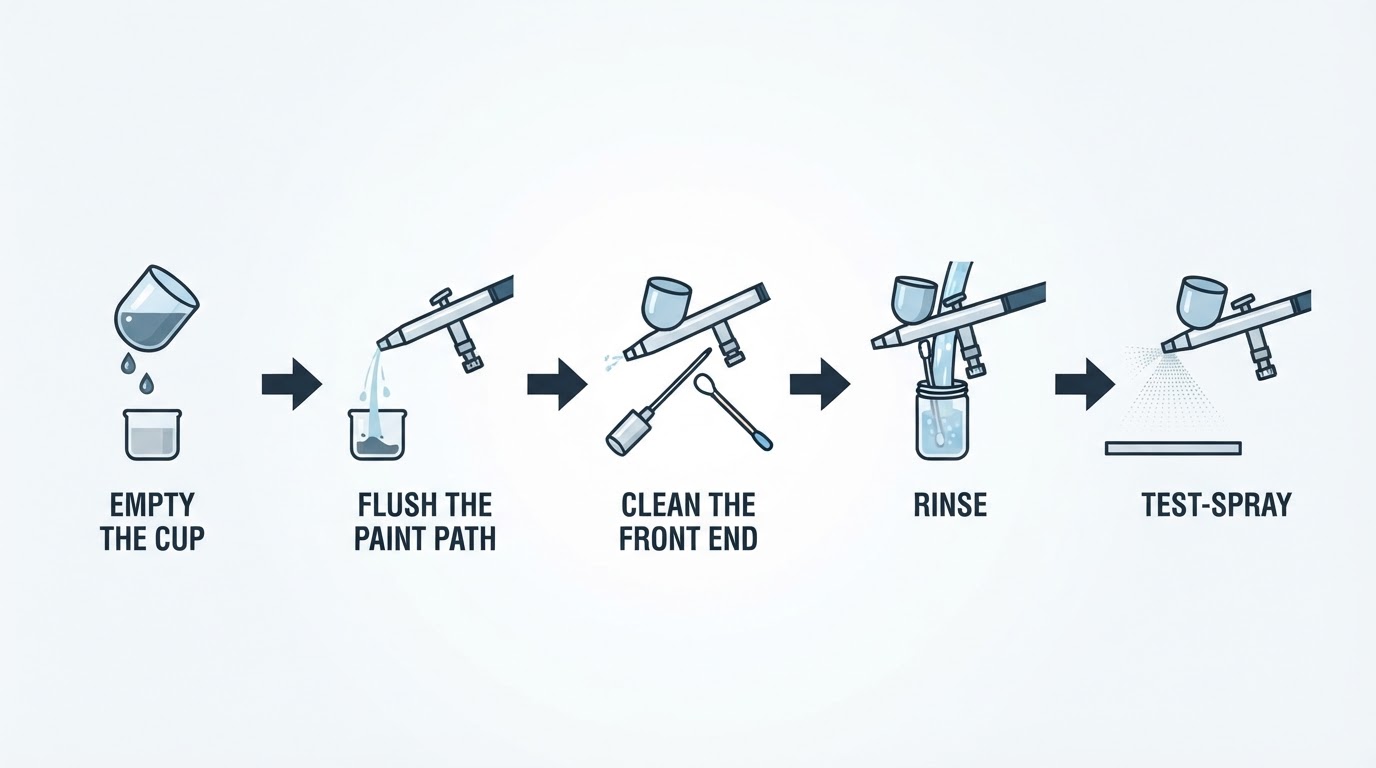
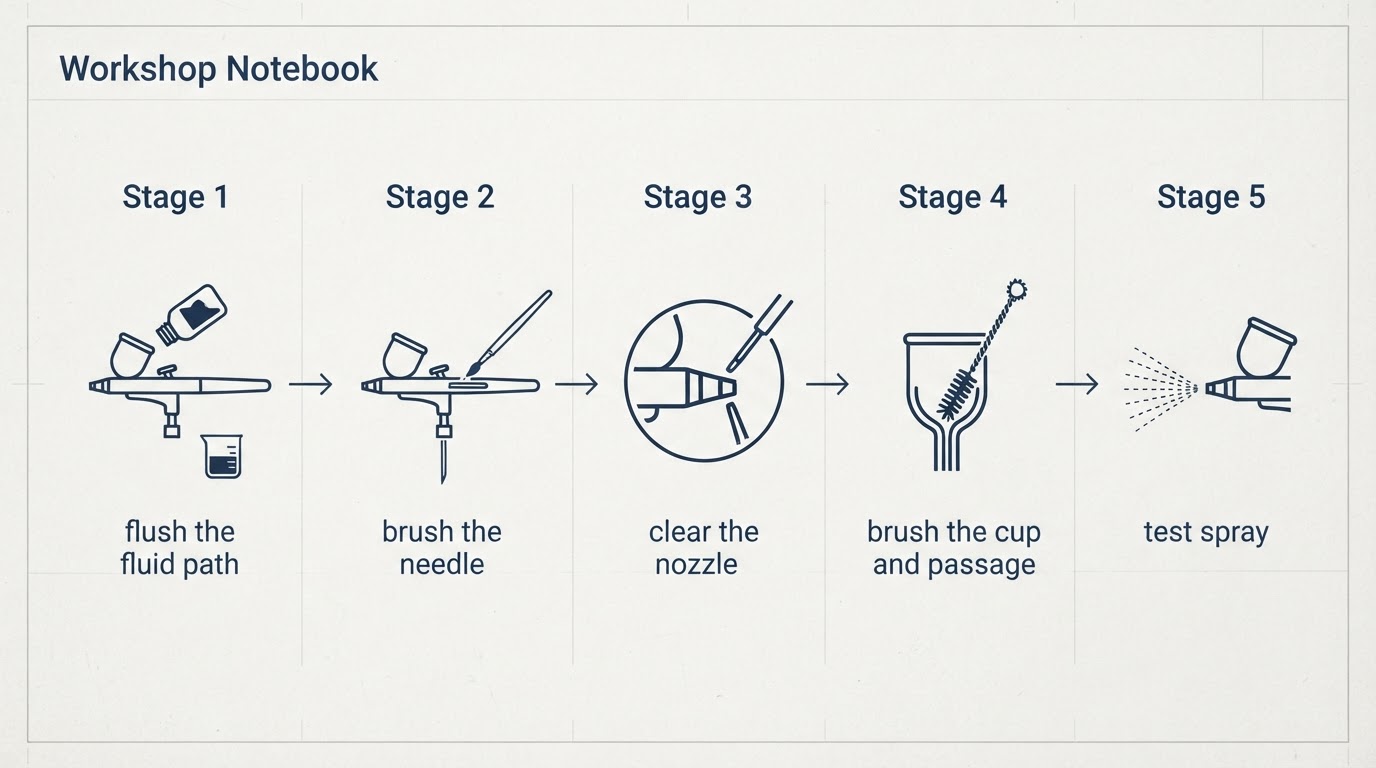
The routine matters more than the bottle, and the highest-value habit is flushing while the paint is still wet. A short sequence works on gravity-feed and siphon-feed brushes alike:
- Dump the leftover paint out of the cup or bottle before adding anything.
- Rinse the cup with a little cleaner and dump it, so you are not pushing a full cup of paint into the brush.
- Spray cleaner through the brush in short bursts, then dump and repeat until the spray runs clear.
- Wipe the tip and needle, and pull the needle for a clean if your manual allows it.
- Finish with a drop of cleaner through the nozzle, then check the pattern on scrap paper.
Your completion standard is simple: a clear, even mist with no spatter, no colour tint and no bubbling. If the pattern is still patchy, the residue is somewhere the cleaner has not reached yet, usually the nozzle or the needle rather than the cup. Deep clean when you switch paint families, when the brush has sat unused, or when the spray pattern degrades after a normal flush.
Common mistakes that waste cleaner
Most cleaning failures are timing or chemistry mistakes rather than product mistakes. The recurring ones:
- Letting paint dry in the brush before the first flush, which turns a rinse into a soak.
- Reaching for a strong solvent on fresh acrylic residue that water-based cleaner would lift.
- Rinsing with water alone on dried lacquer or enamel, where it cannot break the film.
- Soaking the whole airbrush in solvent for long periods without checking whether the plating and seals tolerate it.
- Cleaning the cup and calling it done while the nozzle and needle keep old residue.
- Mixing cleaners in the same cup and hoping two formulas work better than one.
FAQ
Can I clean an airbrush with water alone?
Yes for acrylics while the paint is still wet. No for dried acrylic, and no for lacquers and enamels, which need cleaner and solvent matched to the paint.
Is household glass cleaner safe as an airbrush cleaner?
Only if your airbrush's manual allows it. Glass cleaners are formulated for glass and surfaces, and some contain ammonia or additives that an airbrush is not designed to see, so check first.
Can I use paint thinner instead of airbrush cleaner?
Usually yes when it matches the paint you sprayed, since thinner is made for that paint's chemistry. Confirm the manual lists the solvent as safe for the brush's seals and body first.
How often should I do a deep clean?
When you switch paint families, after the brush has sat unused, or when the spray pattern changes. Between colours within one family, a thorough flush is enough, so a full teardown after every session is optional rather than mandatory.
Do I need a cleaning station or spray-out pot?
No. It is a convenience that captures waste and shortens the routine; a sealed jar and a cloth do the same job.
Is ultrasonic cleaning safe for an airbrush?
It depends on the airbrush. Plating, seals and finishes vary between models, and solvents or heat used in a bath may not suit every brush, so follow the manufacturer's cleaning instructions before dropping parts in.
The bottom line
The best airbrush cleaner is the one that matches your paint and reaches the residue early: water-based for acrylics, solvent-based for lacquers and enamels, the paint's own thinner as the flexible middle ground, and a flush after every session before anything dries.