What a tech marketing agency actually does
For a technical hobby product, buyers may need help understanding a specification, judging fit, or comparing a setup before they buy. A hobby-hardware, airbrush-equipment, or hobby-software business can use a tech marketing agency to explain those decisions. The useful evaluation question is whether a candidate can translate documented capability into a buyer problem, show the evidence behind its claims, and plan work around the actual purchase process.
The work usually spans five areas:
- Positioning and message architecture. Turning a roadmap, an architecture, or a category shift into a clear narrative: who the product is for, which alternative it replaces, and why the difference matters.
- Demand and pipeline programs. Paid and organic campaigns, account-based plays, landing pages, and qualification criteria designed around a buying committee rather than a single persona.
- Content and thought leadership. Technical explainers, comparison pages, customer stories, and the editorial system that keeps them publishing on a schedule.
- Creator and community work. Partnerships with practitioners, analysts, and niche creators who already hold the attention of the audience you want to reach.
- Events and field marketing. Conference presence, owned events, and the follow-up motion that turns conversations into pipeline.
The common thread is translation. Engineers describe mechanisms; buyers buy outcomes, reduced risk, and credibility. An agency that only knows how to run campaigns, without a point of view on the product, tends to produce activity that looks busy and converts poorly.

When a technology brand should bring in an agency
Hiring an agency is not automatically better than building in-house. The question is whether a specific gap can be filled faster from outside.
Consider bringing in outside help when:
- The launch calendar outruns the team. A product release, a category pivot, or an event season creates more work than current headcount can absorb without pausing everything else.
- The category needs education, not just promotion. When buyers do not yet have a name for the problem, the marketing job is to teach the market before selling to it.
- The brand is entering unfamiliar territory. New segments, regions, or buyer personas often need native knowledge the internal team has not accumulated yet.
- A capability is missing and hiring is slow. Creator programs, technical content, and field events are specialist disciplines, and a full-time hire can take months to become productive.
- The internal team needs an outside view. Sometimes the fastest way to sharpen positioning is to borrow people who have watched the same problem play out at other companies.
Stay in-house when the real constraint is strategy ownership. If leadership has not decided who the product is for, an agency will amplify the confusion rather than resolve it.
Services and process to expect
Service menus vary, but a credible tech marketing agency can usually describe its work as a sequence rather than a list of deliverables. Ask each candidate to walk through that sequence using a real example.
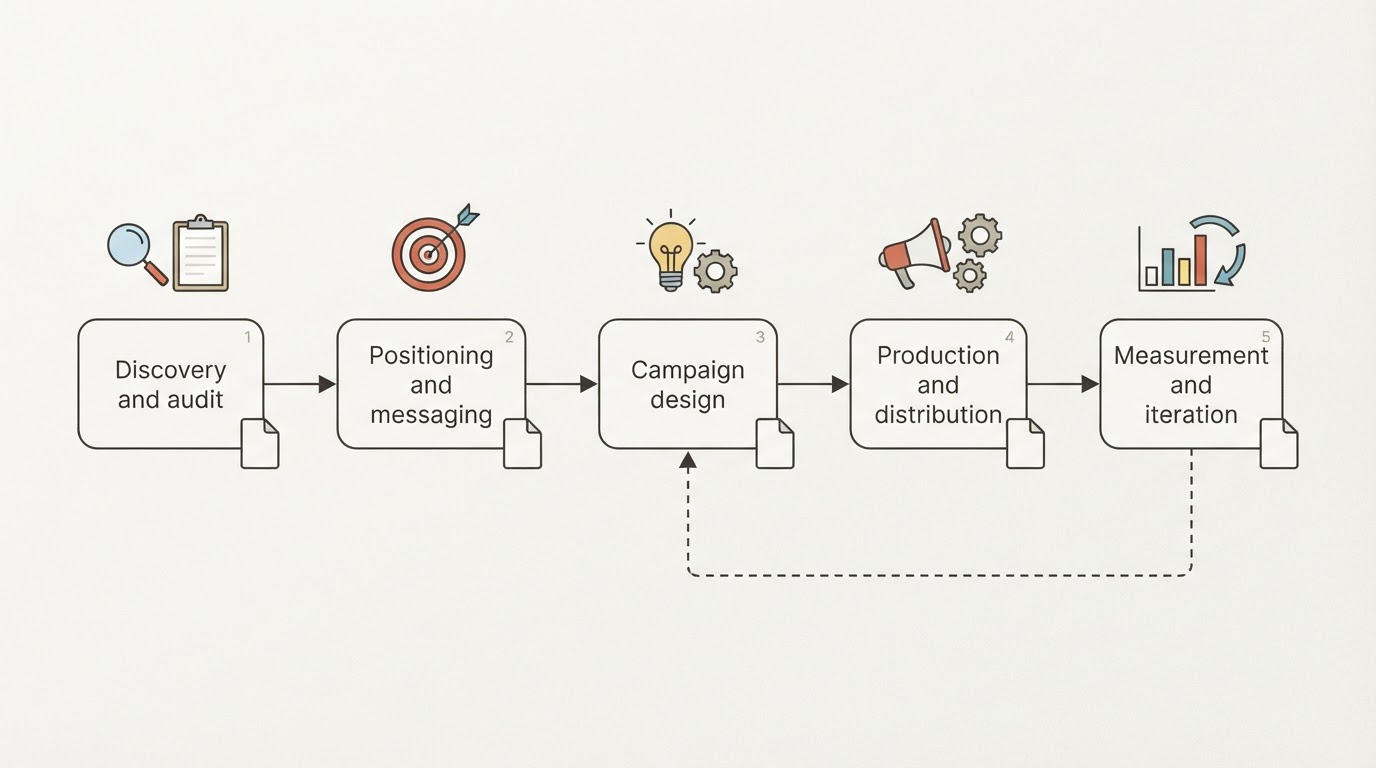
Phase | What happens | What you should receive |
|---|---|---|
Discovery and audit | Interviews with internal teams and customers, plus a review of the current funnel, content, and campaign performance | A written diagnosis of what is working, what is not, and the assumptions behind both |
Positioning and messaging | Message architecture built from that diagnosis | A core narrative, proof points, and messaging by persona, stage, and use case |
Campaign design | Channel, content, and creator plan tied to a measurable goal | A plan with owners, dependencies, and a definition of success |
Production and distribution | Content, creative, events, and creator partnerships | Assets that match the message and reach the audience on a predictable schedule |
Measurement and iteration | Reporting against the agreed goal rather than surface-level activity | A recurring review that changes the plan when the evidence changes |
Two details separate a serious process from a sales pitch. First, the agency can explain what it will do first and why. Second, it names the internal counterpart it needs in each phase: a marketing lead, a product marketer, a founder, or a sales leader. Agencies that quietly assume they own strategy end up in conflict with the team that actually does.
What good onboarding looks like
A useful onboarding sequence produces evidence early, while the relationship is still cheap to change:
- Access and context. Shared analytics, CRM, content library, and a short written brief on the business goal.
- Interviews. Structured conversations with the people who build, sell, and support the product.
- A working diagnosis. A point of view on the market and the buyer, presented for challenge rather than approval.
- A first campaign slice. One narrow program shipped early enough to test how the two teams work together.
- A review with criteria. A session where both sides agree on what will be kept, changed, or stopped.
The completion standard is simple: by the end of onboarding you should be able to explain your positioning in the agency's words and recognize your own customers in its research notes.
How to evaluate a tech marketing agency
Adjectives are cheap. Evidence is not. Use the criteria below and ask for specifics rather than impressions.
Use this as a brief, not a shortcut to a score. Ask each candidate to explain one real product from the manufacturer's documented specifications, cite the evidence behind each technical claim, and walk through an airbrush-equipment example that distinguishes working pressure from maximum pressure and explains the airflow actually delivered. Ask who verifies those claims, who signs off when a claim is challenged, and what happens when the evidence does not support the draft. Then agree one measurable commercial outcome, the reporting that will show it, and the point at which the engagement will be reviewed. These are proposed buying checks, not proof that a named agency will succeed.
Criterion | What to look for | Weak signal |
|---|---|---|
Category fluency | The team can explain your market, your competitors, and the buyer's alternatives without being briefed twice | Vague references to "innovative solutions" |
Technical comfort | Copy and creative use your product's vocabulary correctly | Claims your engineering team would reject |
Full-funnel range | Positioning, content, creators, and events can be coordinated instead of isolated | A single-channel shop with borrowed case studies |
Measurement literacy | Clear definitions of qualified demand, pipeline, and the limits of attribution | Reporting limited to impressions and clicks |
Working model | A named team, decision rights, an escalation path, and a realistic review cadence | Senior names in the pitch, junior names on the account |
References | Buyers from similar companies who will discuss the working relationship, not just the output | Logos with no named people behind them |
A scorecard helps because agency decisions are usually made on chemistry. Chemistry matters, but it should be the tie-breaker, not the primary filter. Score the evidence first, then weigh the people.
The trade-offs that decide whether it works
Every engagement shape has a cost, and the trade-offs are easier to manage when they are named in advance.
- Speed versus control. An agency moves faster when it can make decisions inside an agreed scope, and slower when every asset needs several internal approvals. Decide early where the agency owns the call.
- Specialists versus generalists. A large integrated team brings coordination but less depth per discipline; a small specialist shop brings depth but may need partners for everything else.
- Brand building versus lead generation. Category education takes longer to show pipeline than campaigns that harvest existing demand. Mixing the two without separating their metrics creates false failure.
- Retainer versus project. Retainers suit ongoing category work; project engagements suit launches with a defined end date. Choose based on whether the work is continuous or episodic.
There is also a limitation worth naming out loud: an agency can sharpen and amplify a story, but it cannot manufacture product-market fit. If the product does not yet solve a problem someone will pay for, marketing tends to make the gap visible faster rather than close it.
A practical selection sequence
If you want a defensible decision rather than a preference, run this sequence:
- Write the brief before you talk to anyone. One page covering the business goal, the buyer, the product stage, the budget range, and the decision you need the agency to influence.
- Screen on evidence. Shortlist three to five agencies whose public work demonstrates the exact capability you need, not the broadest possible menu.
- Ask for a diagnosis, not a deck. In the pitch, request their read of your market and one recommendation you did not expect to hear.
- Check the working relationship. Speak with a current client and a former client, and ask what changed when something went wrong.
- Agree the measurement before the media. Define the metric the engagement will move, and how it will be reported, while the contract is still being drafted.
- Start with a bounded first program. A launch, a vertical, or a single event gives both sides a low-risk way to test the fit.
The engagement is working when the agency brings you conclusions you had not reached, when internal teams adopt its messaging without being asked, and when the reported result matches the goal you agreed at the start. If those three signals are missing after a full campaign cycle, the problem is the fit, not how often you receive a report.