Why the lid changes the spray
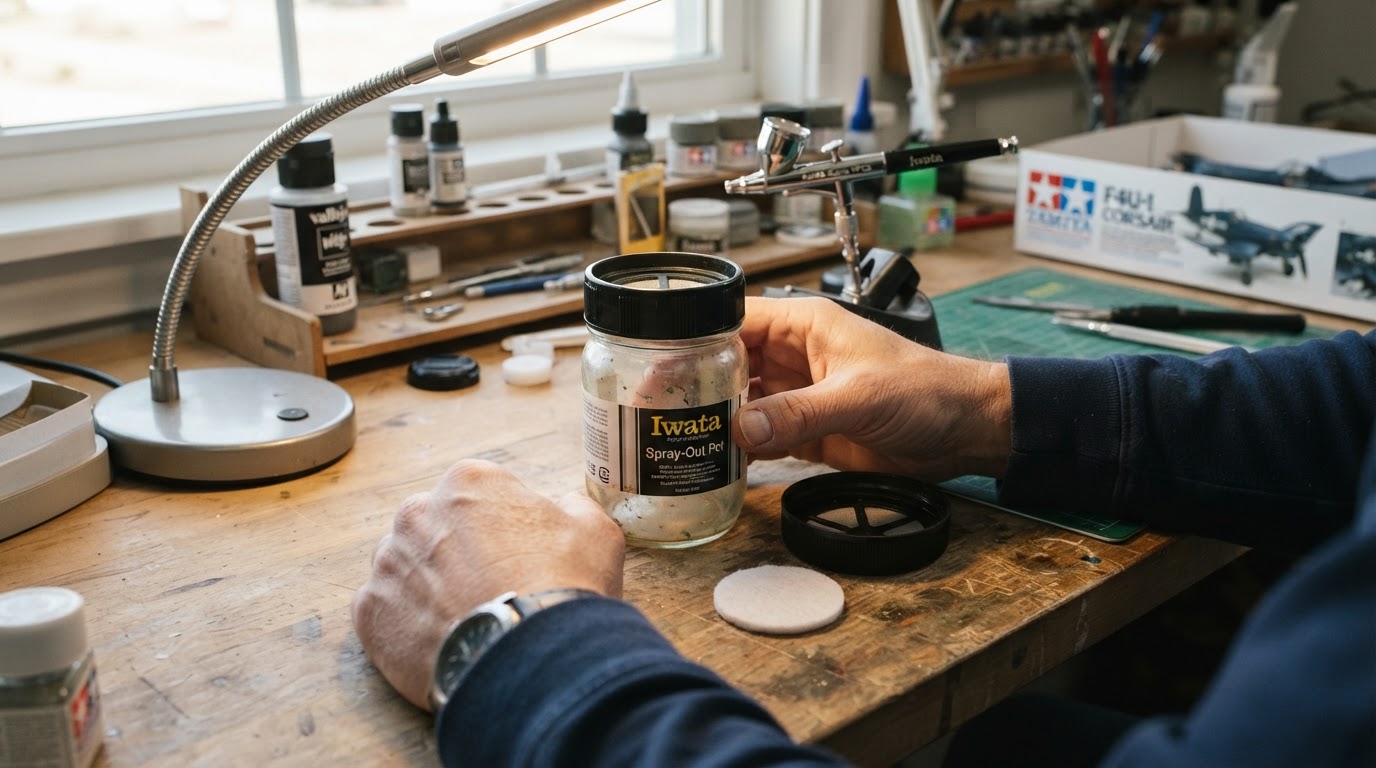
A gravity-feed color cup is open by design, so a cap needs a way for air to enter as paint leaves. Golden Artist Colors describes the vent hole as the reason a vacuum cannot develop in the cup, and says it must stay open for flow; bottle caps carry it for the same reason. Iwata's basics guide notes most gravity cups include a secure lid, which prevents paint spills, so a lid sealing the cup without a working vent trades a spill risk for a flow problem.
That vent is not an air-supply port: compressed air enters through the air valve and nozzle, while the vent keeps the fluid side at atmospheric pressure. Some vented gravity cups use a cap with a hole; verify your model.
Separate the two symptoms before you clean anything
The vent explains one pattern only. Record what the brush does with the cap on and off before changing anything.
What you see | What it points to | Next safe check | Stop when |
|---|---|---|---|
Flow drops or stops only once the cap is fitted | A plausible contributor, not a verdict | Vent per your manual, then the comparison below | The cap is cracked, or the vent cannot be seen or cleared safely |
No paint with the cap on and with the cap off | A wider no-paint fault; multiple faults are possible | The broader fluid-path checks for your model | You are about to force, drill, or dismantle beyond your manual |
Bubbles appear, or the cap lifts or pops | Air is entering or reversing in the fluid path | The front end and any reverse-air path your manual describes | You are tempted to call the vent proven |
Paint weeps at the cap | Cap sealing or a mismatched part | Compare the cap and its seal with the parts diagram | The cap is not the part your model lists |
Unexpected positive pressure means air is moving the wrong way through the fluid passage. A blocked vent starves a reservoir but does not push air back, so bubbling is not evidence of a vent fault. If paint bubbles, pops, or lifts the cap, use the reverse-air and bubbling checks instead.
No paint with the cap off too does not prove the lid is unrelated: multiple faults are possible, so widen the diagnosis with the broader no-paint checks before stripping the nozzle.
Find the vent your model actually has
Use your manual or parts diagram, not a generic photo. Arrangements differ between models, so confirm the part number before assuming a visible opening does that job. Paint, including partly cured residue, can block the vent.
A safe cap-on, cap-off observation
Run this only for a removable gravity-cup cap, and only if your manual allows normal spraying with the cap off; otherwise follow the manufacturer's guidance.
- Work in a ventilated area with the PPE your paint and cleaner require.
- Load a small amount of the actual paint you were spraying, mixed as usual.
- Hold the brush upright. Do not tilt or turn the cup toward you.
- Stop the trigger and the air before you remove or refit the cap.
- Make otherwise identical short passes, first with the cap off and then with it on.
- Repeat the pair before you conclude anything.
A repeatable difference suggests the cap contributes something, but it does not confirm the vent as the cause or cleaning as the cure. Identical results do not conclusively rule the lid out either.
Cleaning and stop rules
- Clean only with the agent the maker approves for that cap and model, following its contact-time instructions.
- Do not drill, enlarge, or ream the vent. Do not tape over it or otherwise bypass the cap.
- Do not force a wire or a sharp needle through the hole.
- Do not soak the whole brush in solvent to solve a cap problem.
- Do not chase the symptom with a higher pressure number. No single pressure setting fixes a blocked vent.
Ask the manufacturer when the cap is damaged, the replacement is not your model's part, or the vent cannot be cleared with approved cleaning. If the fault persists after the vent is clear, do not order a new nozzle on this symptom alone: more than one fault is possible, so widen the checks.
What this check cannot tell you
Never open or remove a siphon bottle while the brush is spraying, and never disconnect parts while the system is pressurized. Follow your manual, release pressure by its procedure, then clean.