What "sticking down" actually means
A double-action airbrush gives the trigger two jobs. Pressing straight down opens the air valve; pulling back moves the needle to release paint, as the Iwata Eclipse series manual describes it.
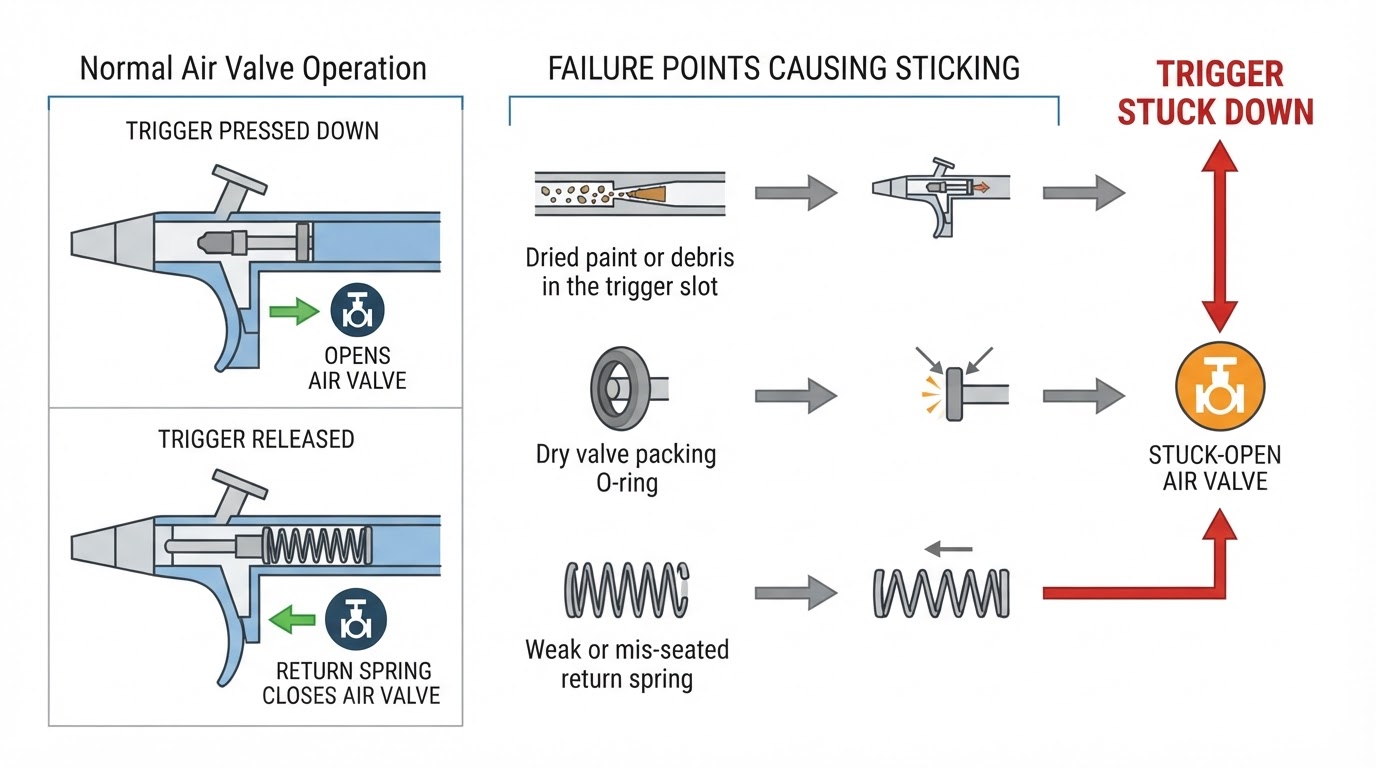
So when the trigger stays depressed and air keeps flowing after you let go, the problem is on the air side. The needle spring can return the paint control while the valve that shuts off air is still hanging open.
That differs from a trigger that only sticks backward when you pull it to spray paint, which points to needle or packing friction, and from tip dry or a clog, which changes the spray pattern while air still starts and stops on command.
Disconnect air first, then run the three-minute checks
- Disconnect the air hose, or close the regulator and bleed the line. Never test the trigger with your fingers inside the valve and pressure connected.
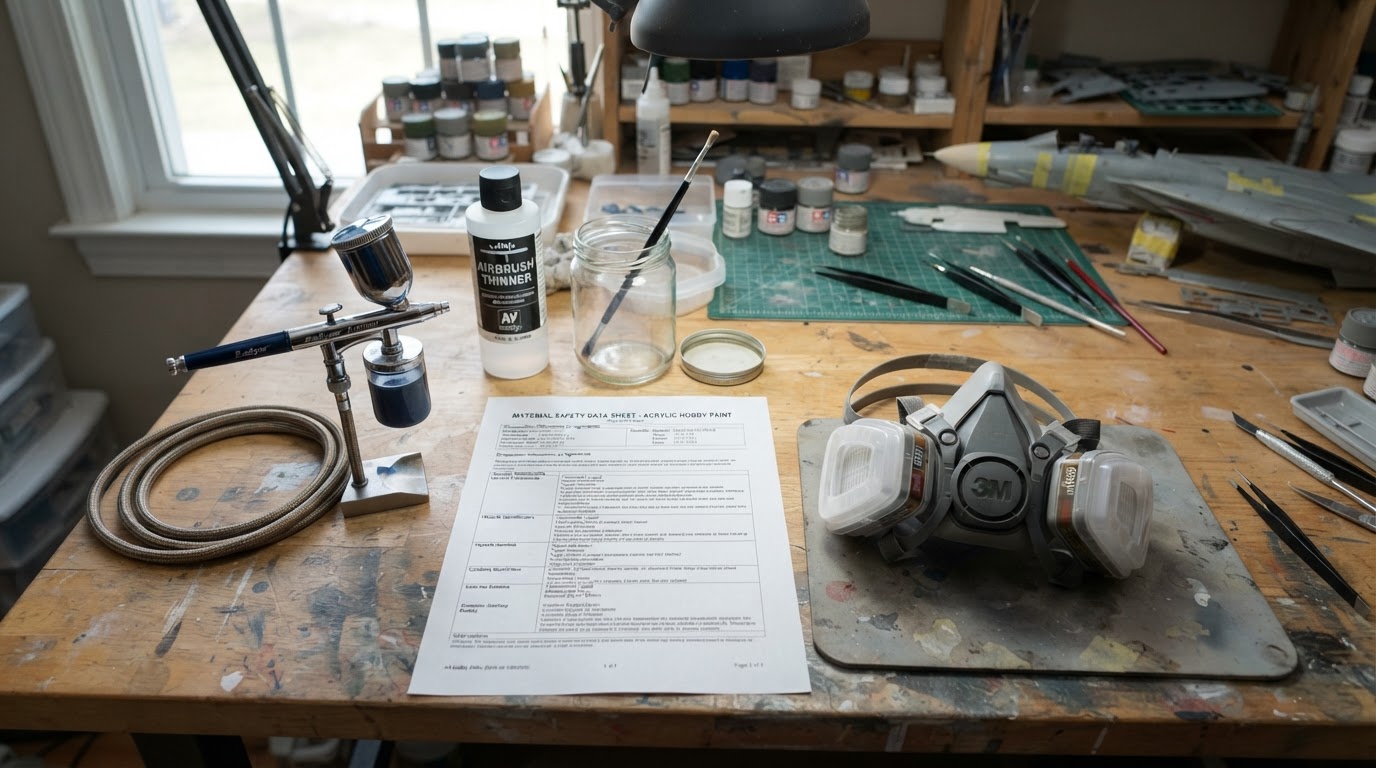
- Note the exact model and find its parts diagram. Part names differ: Iwata calls the trigger a "main lever" and lists an "air valve spring"; the Grex Tritium owner's manual lists a "trigger with grip" and a "slider spring" in its air valve assembly.
- Press down only, without pulling back. If air continues after you release, you have confirmed an air-valve fault.
Decision table: match symptom to likely cause
What you see | Likely cause | First action |
|---|---|---|
Air keeps flowing; trigger rises slowly | Friction in the air valve, often a dry valve packing O-ring | Lubricate exactly as your manual describes |
Trigger sits low and feels gritty | Dried paint or debris in the trigger area | Remove the handle per the manual, clean the slot, add no oil |
Air stops only when you lift or tap the trigger | A weak or mis-seated return spring, or wrong assembly order | Compare with the parts diagram; fit a brand spring |
Air stays on right after a strip-down | Valve guide screw or piston not seated | Re-assemble in the manual's order; never force brass |
Air starts and stops fine, but the trigger will not pull back for paint | Needle or packing friction, a paint-side fault | Clean and lubricate the needle per the manual |
Clean what the manual lets you open
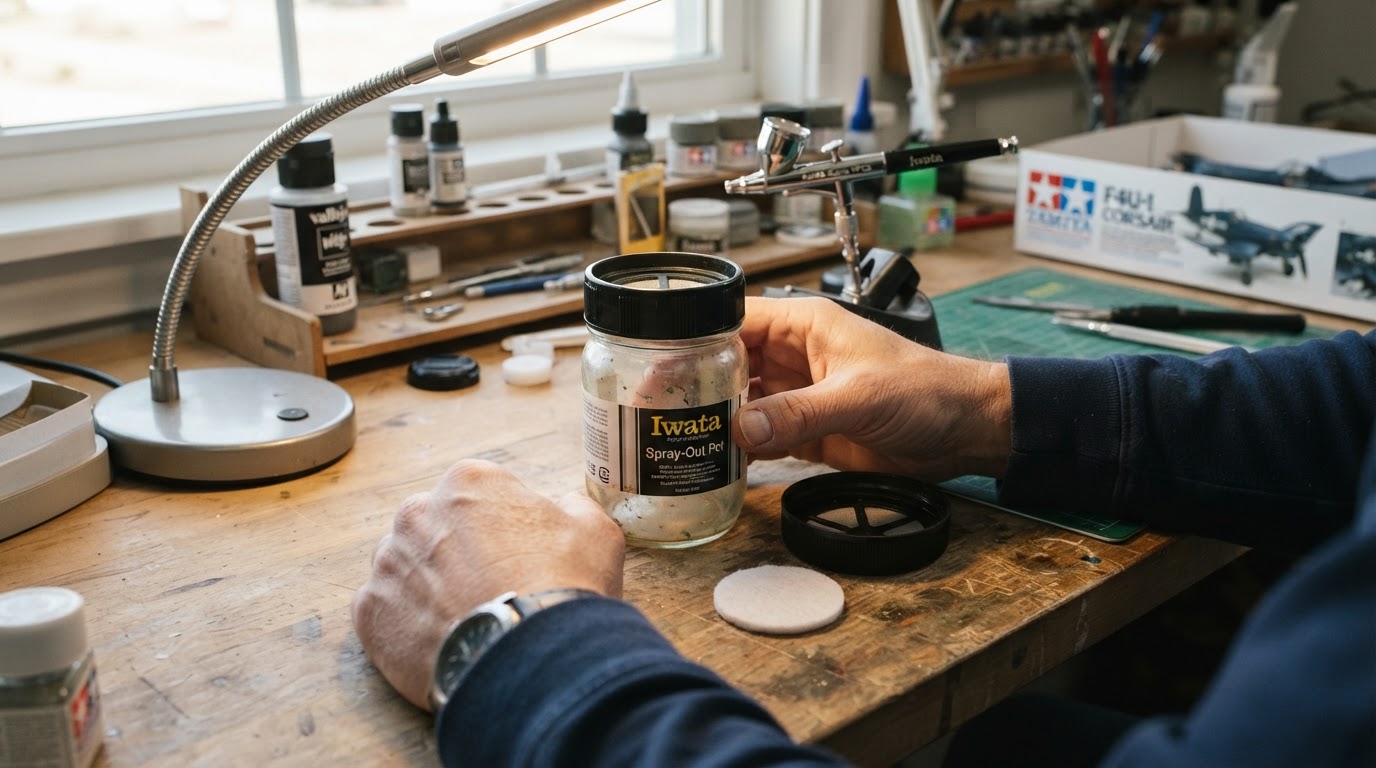
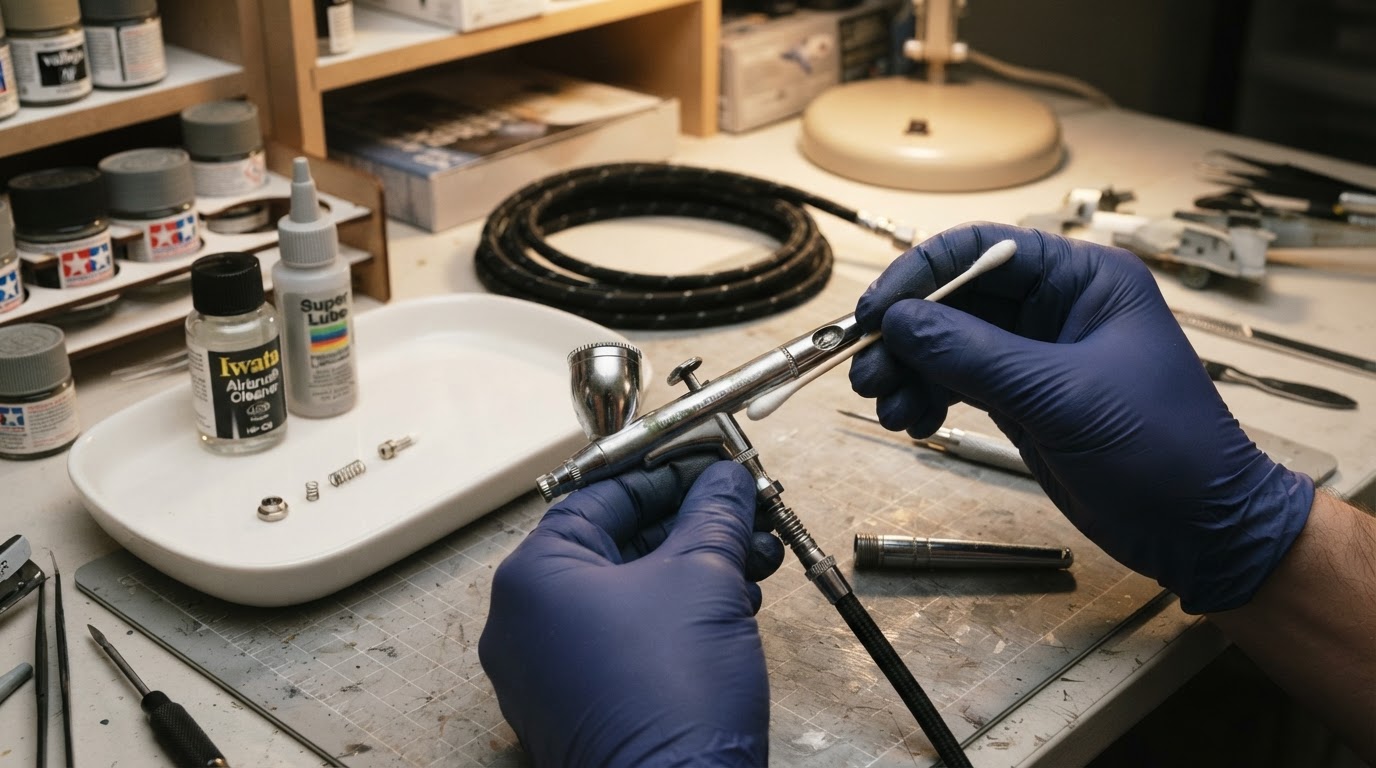
- Expose the trigger slot and valve area by following the maker's order of parts. Iwata's manual notes that tools are usually unnecessary and says not to use pliers.
- Swab the slot and valve stem with a cotton swab dampened with the cleaner recommended for your paint. Grex warns against submerging the whole airbrush in solvent, because fluid can reach the air valve and damage its seals and O-rings.
- Do not scrape with metal tools or abrasives.
- Lubricate sparingly. Iwata says to drip one drop of a suitable airbrush lubricant into the slot directly behind the main lever, and warns that over-lubricating can push excess into the nozzle and cause paint-flow problems.
- Never use household oils or unknown solvents on seals. Iwata warns specifically that light machine oil and WD-40 make parts stick instead of freeing them.
- Fully reassemble according to the model manual before reconnecting air and testing the trigger. Stop if a part does not seat without force.
When cleaning is not enough
If the slot is clean and correctly lubricated but the trigger still stays down and air still runs, the fault is mechanical: a tired return spring, a swollen valve seal, a scored valve body, or a piston that no longer slides true. Cleaning is maintenance; replacing the failed part is the repair. Change only that part, using the number for your model, and keep the old one until the new one proves the diagnosis.
If the symptom persists or returns, do not assume repeated lubrication is a repair. Inspect the serviceable parts specified by your model's manual or ask a qualified service center.
Model-specific differences matter more than the brand name
- Iwata Eclipse manual: the trigger is part 12, the "main lever"; the air valve group includes the air valve, air valve spring, air valve guide screw, and valve piston O-ring. Its troubleshooting table pairs a dirty airbrush with a dried-out air valve packing O-ring and prescribes lubing the trigger housing.
- Grex Tritium manual: lists a trigger with grip, a slider spring, and an air valve assembly, and maps restricted trigger movement to dried paint or debris in the trigger area.
The principle is shared; the parts, numbers, and disassembly order are not. The manual for your own airbrush is the authority, not this page and not another brand's diagram.
Limitations
- A description or photo cannot confirm the fault; a swollen seal and a weak spring feel nearly identical until the unit is open.
- Some models do not sell the return spring separately, and some valve assemblies are replaced as a unit.
- If solvent has swollen the seals, or the valve body is scored, cleaning will not restore the seal.
- Compressed air is dangerous with the unit open; disconnect it before any inspection.
- If in doubt, use the maker's service or the correct OEM part rather than an aftermarket guess.
If air starts and stops normally but paint dries at the nozzle, see our separate airbrush tip-dry guide.
FAQ
Can I use sewing machine oil or WD-40 to free a sticking trigger?
No. Iwata's manual says light machine oil and WD-40 cause parts to stick rather than free them; the same caution applies to unknown solvents on seals. Use the lubricant your manufacturer specifies, and only a drop.
Why does air keep flowing after the paint stops?
Air and paint are controlled separately. Pressing down opens the air valve; pulling back moves the needle to release paint. The needle can return while the air valve is still hanging open.
How do I tell a sticking trigger from a clogged or dried-out tip?
A clog or dried tip changes what leaves the nozzle while air still starts and stops on command. If air keeps running with the trigger released, the fault is in the air valve or the trigger return.