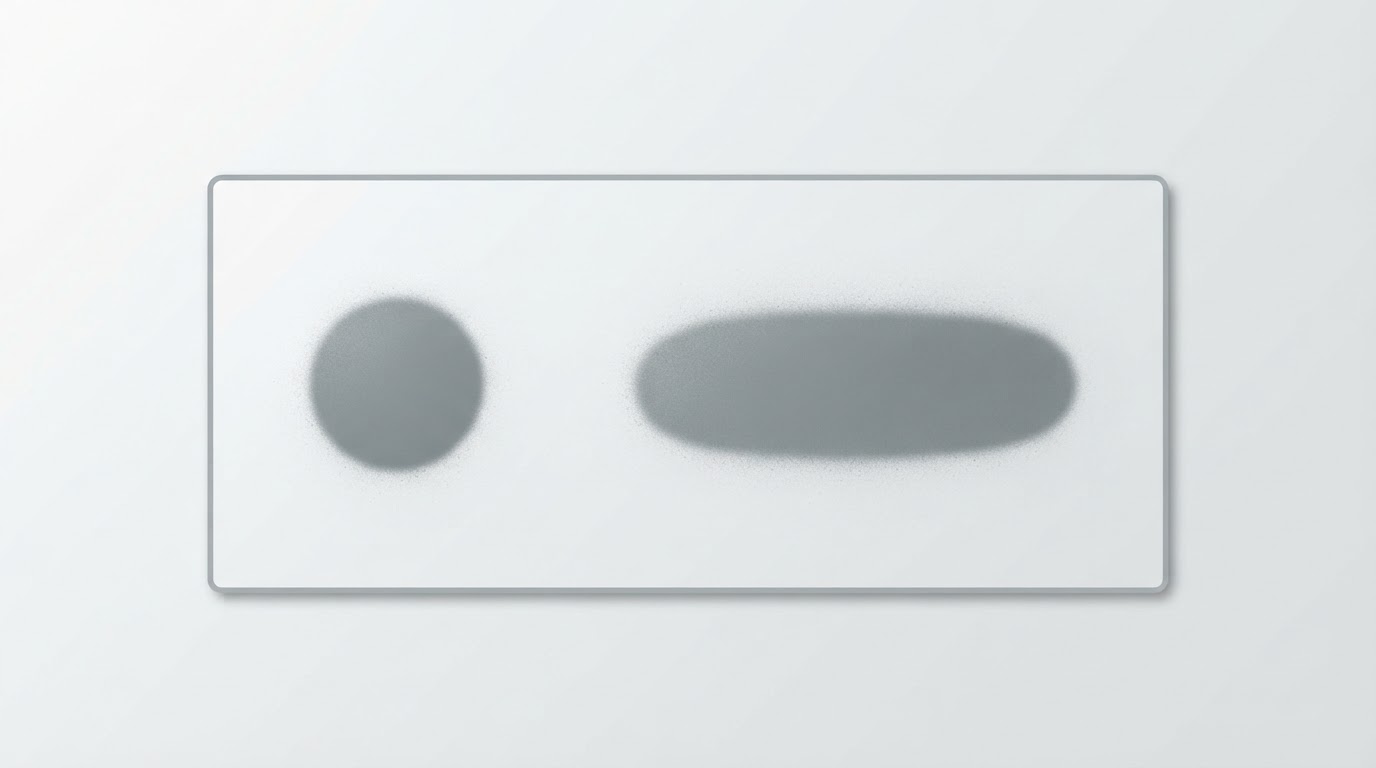
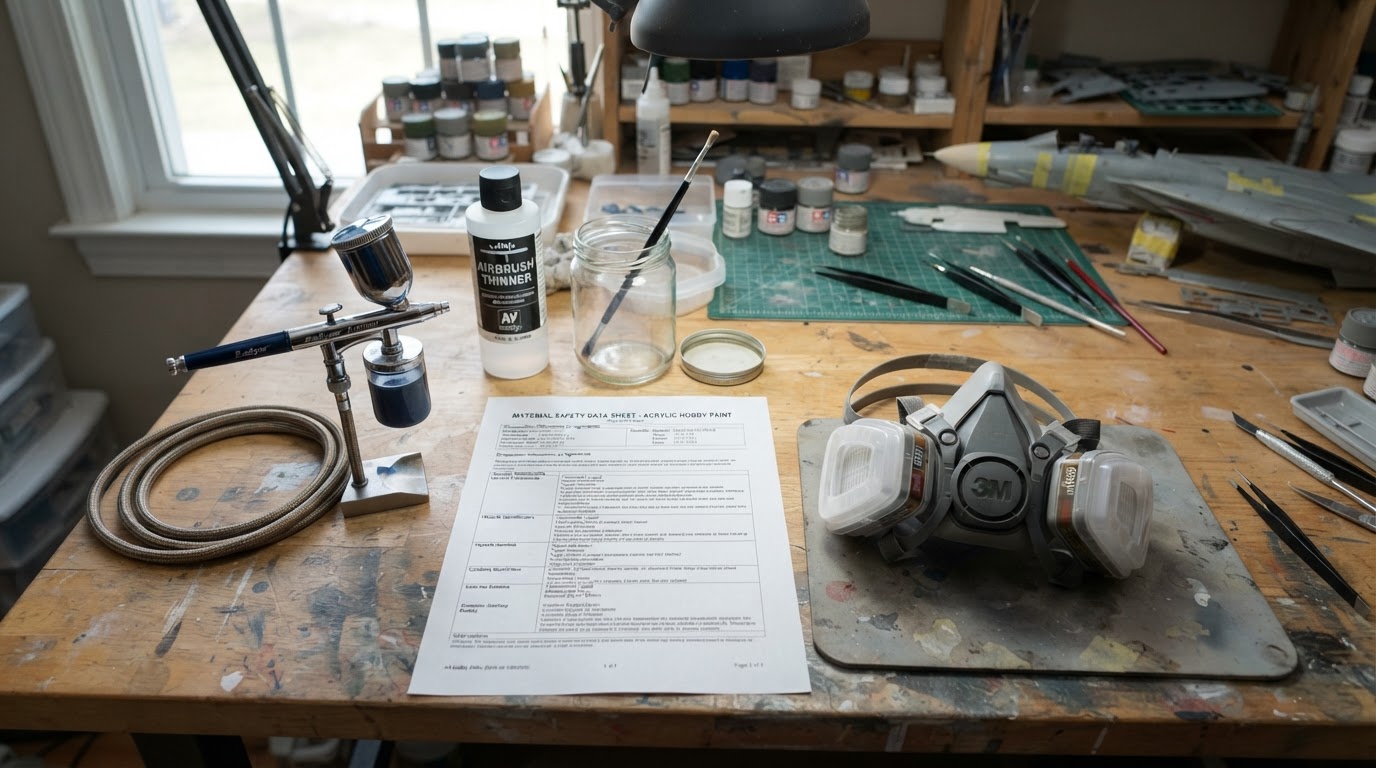
The honest answer: it depends on the paint, not the word "acrylic"
Acrylic is a family, not a specification. A fluid artist acrylic, a heavy-body tube acrylic, a model brush acrylic and a craft-bottle acrylic can all carry the word "acrylic" on the label and still behave completely differently inside a 0.3 mm nozzle. What decides the outcome is how finely the pigment is ground, what else is in the bottle, and how thin the product already is.
That is why some makers publish a conversion path and others do not. Golden Artist Colors' airbrush guidance describes thinning some of its acrylic lines with a compatible medium, while noting that thick paints require more preparation and may sacrifice pigment load. That is guidance for Golden products, not proof that every regular acrylic can be converted.
The four things that decide whether it will spray
1. Paint family. The thicker and more gel-like the product, the harder it is to reduce. A fluid or soft-body acrylic starts close to a sprayable consistency; a heavy-body tube paint starts far away. Craft acrylics sold for brushing often contain fillers and stabilizers that were never intended for a nozzle, so treat them as unproven for airbrush use rather than as a shortcut.
2. Pigment particle size. This is the factor hobbyists skip and manufacturers talk about most. Golden's High Flow Acrylics reference says "some pigments are not well suited for use in airbrushes with small nozzles and fine tips," and its chart names colors that are harder to spray. A color that sprays at 0.5 mm can clog a 0.2 mm setup.
3. A maker-approved thinner or medium. Use the product the maker names for that exact line — an acrylic airbrush medium, a branded acrylic thinner, or water only where the label allows it. Ratios come from the maker's instructions, not from a forum table. Never add a solvent or automotive reducer to a water-based acrylic; if the label does not name it, it does not belong in the cup.
4. Nozzle size. Fine-detail airbrushes are far less forgiving. If your brush runs a 0.2 mm or 0.3 mm tip, you are working at the hard end of the range and should expect fewer colors and thicker paints to pass through.
Decision matrix: can this acrylic go in your airbrush?
What is in the bottle | Realistic verdict | What the maker must allow | Nozzle reality |
|---|---|---|---|
Airbrush-ready acrylic | Yes, as-is | Nothing extra | Any size the maker lists |
Artist fluid acrylic | Sometimes, after conversion | That brand's airbrush medium | Check the maker's pigment and nozzle guidance |
Artist heavy-body acrylic | Possible but harder | Water first, then airbrush medium only where the maker says so | A larger nozzle may be needed; strain if directed |
Model brush acrylic with a maker thinner | Sometimes, per label | That maker's acrylic thinner | Test with the actual nozzle and paint color |
Craft-bottle acrylic | Unproven | No published airbrush guidance | Clogging risk; do not assume it is safe |
Treat every "yes" in that table as conditional. The same bottle can be fine for broad base coats and hopeless for fine lines.
How to test a mix before you commit a model
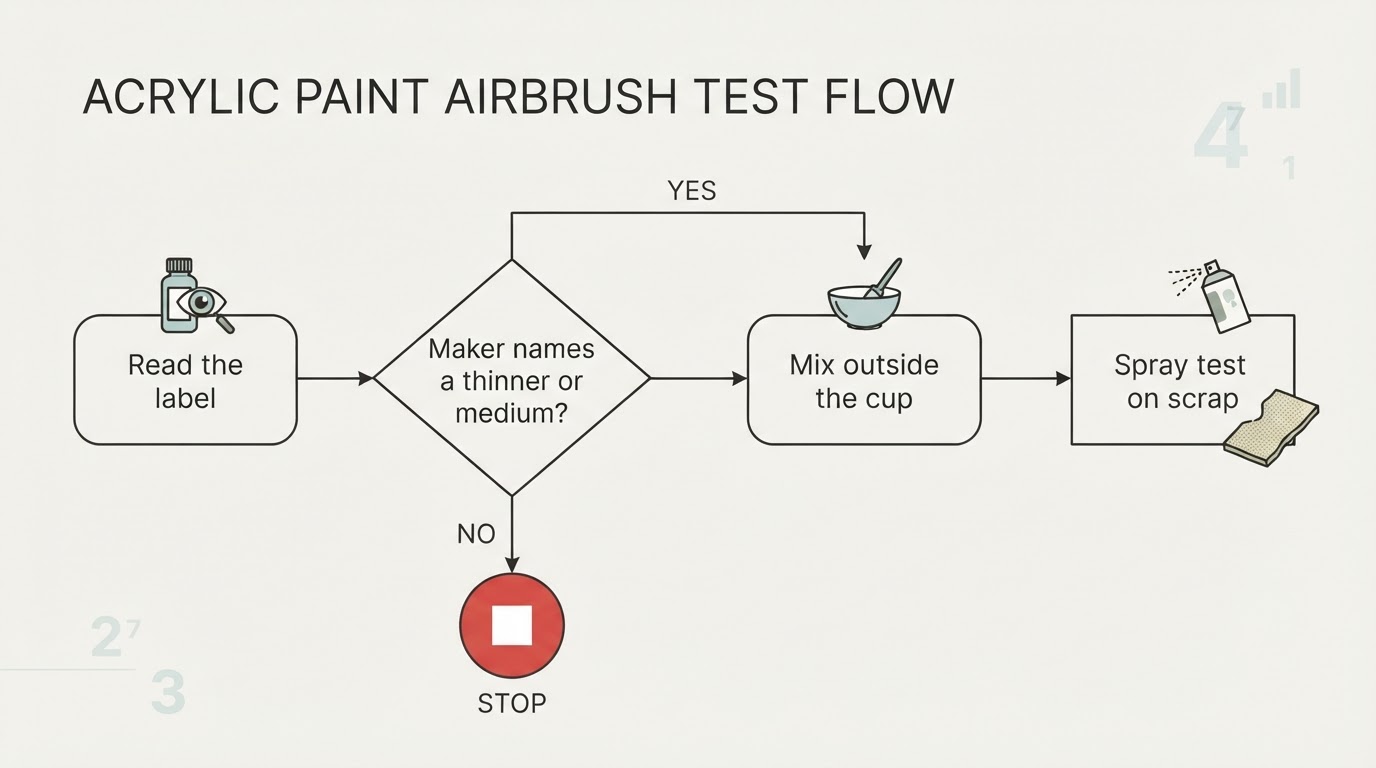
- Read the label first. If the maker says nothing about thinning or airbrush use, the compatible thinner is unknown. Stop there, or test only on scrap.
- Mix outside the cup. Use a small mixing cup and add the maker-approved medium or thinner in small increments. Write down what you actually used.
- Follow the maker's order for thick paint. Golden's guidance describes first making its heavy-body acrylic pourable, then adding its Airbrush Medium. Do not copy that process to an unrelated brand without checking its instructions.
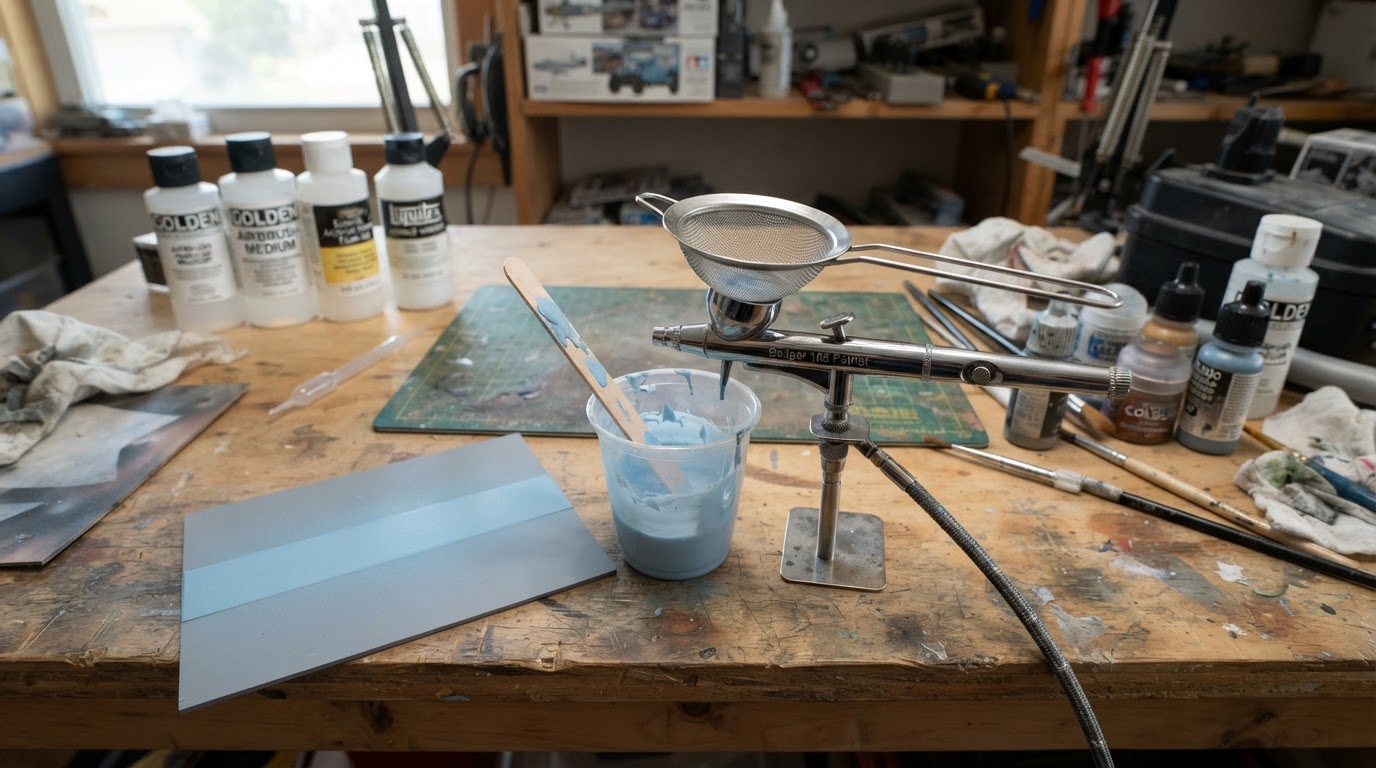
- Strain only when it is justified. Golden says a diluted mixture "may" need straining through cheese cloth, nylon or a #8 mesh or finer screen to remove large particles. Smooth, clean, fresh paint usually does not need it; paint with skins or clumps is exactly what the step is for.
- Spray a test pattern on scrap at the pressure you intend to use. Watch for spatter, tip dry and weak coverage before the mix touches a model.
Control the mist. Golden's own guidance recommends "at minimum, the use of a NIOSH approved disposable dust and mist respirator," alongside sensible ventilation.
Before spraying any artist color, check its label and safety sheet. Golden specifically says not to spray its genuine cadmium pigments or listed zinc-white-containing Fluid Acrylic colors; a thinner and respirator do not turn a prohibited color into a spray-safe one.
Limits worth accepting up front
- There is no universal ratio. Manufacturer starting points assume a particular product, nozzle and air pressure; your setup changes the number.
- Water has limits. Golden notes that adding over 20% water to its High Flow line "begins to change other properties," and heavy water additions weaken the paint film.
- Big, dense pigments settle. Golden warns that coarse pigments "tend to settle quickly when thinned to sprayable consistency" — mix small batches and do not store thinned paint for long.
- Some products will not reduce enough for conventional spraying, and no additive fixes a paint that was formulated for a brush.
- Never let paint dry inside the airbrush, and clean with what the maker approves for that product.
What about the opposite question?
If you already own airbrush-formulated paint and want to apply it with a hand brush, see our separate brush-painting with airbrush paint guide. The direction matters — converting a brush paint for a nozzle and applying a pre-thinned paint by hand are not mirror-image tasks, and each has its own test-first rule.
Three quick FAQs
Can I just add water to any acrylic and spray it?
Only if the maker allows water for that product, and even then within limits. Golden permits water thinning in its High Flow line but warns that over 20% water changes the paint's properties; its Airbrush Medium exists to keep sprayability while reducing the paint. If the label does not discuss water, do not treat it as a universal thinner.
Do I need to strain every mix?
No. Golden describes straining as something that "may be necessary" for diluted mixtures, to catch large particulate material. If the paint is smooth, well mixed and fresh, straining usually is not the variable that decides success. Strain when you see skins, clumps or dried bits, or when the maker directs it.
Can I use lacquer thinner or another solvent to thin water-based acrylic?
No. Use only the thinner or medium the maker names for that product. Water-based acrylic and solvent-based paint are different chemistries, and mixing them is how paint curdles, separates or clogs. If in doubt, leave it out.